
Day 9 - Mercer Works
Clara called the realtor at 9:15 AM.
She had been putting it off.
Not consciously.
At least not until she saw the name on her calendar for the third morning in a row and realized she had somehow found time for Jack's workshop, her mother's cookies, multiple conversations with Naomi, and an hour lying underneath a dining table.
But not twelve minutes with the woman responsible for selling the house, the entire reason she had come here.
Avoidance, Clara had learned, often wore business casual.
“Good morning,” the realtor said brightly. “How's the sorting going?”
Clara looked around the dining room.
One box open.
Three boxes newly labeled.
Christmas decorations where there had been none.
“Productive.”
This was technically true.
“Wonderful. I have a photographer tentatively available next Thursday.”
Clara's stomach tightened.
“That soon?”
A pause.
“You mentioned wanting everything ready before you left.”
“I do.”
She did.
Of course she did.
The plan had not changed.
December twenty-sixth.
Chicago.
January issue.
Normal life.
“Next Thursday is fine,” Clara said.
“Perfect. And if you're comfortable, I'd love to walk through on Tuesday so we can talk staging.”
Staging.
The word annoyed her unexpectedly.
The house did not need staging.
The house had forty-seven years of evidence in it.
Then Clara remembered the point was to remove the evidence.
“Yes,” she said. “Monday works.”
When the call ended, she stayed at the table.
The box lay beside her laptop.
The train ticket.
Next year?
Maybe.
She moved it aside.
Not because she was upset.
Because she had work.
At ten, Clara joined the weekly editorial meeting from her father's dining room.
Twenty-one faces filled her screen.
New York.
Chicago.
Los Angeles.
A photo editor calling in from Sweden.
Her deputy in the office conference room.
Her own empty chair was visible behind him if she looked closely enough.
Clara had spent thirteen years at Form & Home.
Seven as Editorial Director.
She knew every recurring feature, every deadline cycle, every advertiser panic, every photographer who would somehow find good light in a windowless basement.
The magazine was not her whole life.
But she had built much of her life around it.
And she was proud of that.
“January opener,” her deputy said. “We need a decision by Noon.”
Three layouts appeared.
Clara studied them.
“Second.”
“Really?”
“Yes.”
“The first one tested better internally.”
“The first one looks like a hotel lobby trying to win an award.”
A few people laughed.
She pointed toward the second.
“This one looks lived in.”
Her art director nodded.
“I agree.”
“Then use it.”
They moved on.
Fifteen minutes later they were discussing a feature on a restored modernist home outside Palm Springs.
Then a profile of a ceramicist.
Then a spring package about heirloom design.
At the word heirloom, Clara remembered the framed magazine spread hanging in Jack's shop.
Something nagged.
“Wait,” she said.
Everyone stopped.
Clara searched her laptop.
The magazine's digital archive opened.
She typed:
Mercer Works.
There it was.
October 2020.
The New American Heirloom.
She clicked.
The article filled the screen.
She had skimmed it at Jack's office.
Now she read.
Really read.
The piece was by Dana Whitaker, one of their former contributing editors.
Clara remembered Dana.
Smart.
Excellent taste.
Terrible about deadlines.
The feature opened:
In a small town in Holloway, Wisconsin, Jack Mercer is giving old things new life — and a future.
Clara stopped.
Continued.
Tables.
Chairs.
Desks.
Reclaimed wood.
Traditional joinery used in contemporary forms.
A photograph of Jack sanding the edge of a table.
Younger.
Forty-two maybe.
No gray yet at his temples.
The article quoted him:
“I don't see old things as broken, I see them as unfinished..”
Clara read that twice.
Then:
“Each piece has a past, my job is to listen to it, respect what it’s been and help it become what it can be next.”
Clara leaned back.
Of course he had said that.
It was aggressively Jack.
“Clara?”
She looked at the screen.
Her managing editor was waiting.
“Sorry.”
“Everything okay?”
“Yes.”
She minimized the article.
“Where were we?”
“Spring heirloom package.”
Clara almost laughed.
“Right.”
After the meeting, she reopened the feature.
The staff credit.
Editor: Morgan Ellis
Not Clara.
She remembered that year now.
October 2020.
She had been managing the entire publication remotely.
Her marriage to Michael was ending.
Her mother had already been gone ten years.
Her father was healthy.
The world had felt both paused and catastrophically fast.
She had approved thousands of pieces of copy that year.
Maybe even this one.
She couldn't remember.
That unsettled her.
Not because she believed fate should have delivered Jack's name to her with flashing lights.
Because it had passed directly through the institution she ran.
One degree away.
Maybe less.
And she had never noticed.
Clara clicked through the images again.
One piece caught her eye.
A dining table.
Long.
Pale wood.
Caption:
The Ridge Dining Table, reclaimed oak, restored and reimagined by Mercer Works.
She smiled.
Ash.
Apparently.
She zoomed in.
The table was beautiful.
Behind the table in the photograph.
A writing desk.
Simple lines.
A drawer nearly invisible from the front.
And there, on the back edge, a narrow brass detail.
Clara knew that desk.
Not literally.
But she knew the design language.
The restraint.
The decisions.
She had spent thirteen years looking at rooms and objects, learning to recognize when something had been edited until nothing unnecessary remained.
Jack was good.
Not good for Holloway.
Not good for someone she'd once dated.
Good.
Period.
Clara sat with that longer than she expected.
At twenty-three, when Jack said he wanted to stay and build furniture, she had translated it into:
He doesn't want enough.
She had not said those words exactly.
Not at first.
But she'd believed them.
She had believed geography was ambition.
That leaving proved hunger.
That staying suggested its absence.
Clara closed the laptop.
“Damn it.”
No one answered.
At one thirty, she texted Jack.
I read the article.
He responded eight minutes later.
I’m sorry.
Why are you sorry?
The caption.
Clara laughed.
You were right. It’s Ash.
Thank you. Closure.
I meant I’m sorry about the whole article.
A pause.
Oh.
You’re very good.
Three dots.
Gone.
Back.
Thank you.
That was it.
Clara frowned.
That’s all I get?
You complimented me yesterday. I already used my quota.
I’m serious.
Another pause.
So am I. Thank you.
Clara looked at the screen.
There was something almost shy in it.
Unexpected.
She typed:
I didn’t know.
This time the response took longer.
I know.
Not accusation.
Not wounded.
Just fact.
Clara didn't know why that made her feel worse.
I should have.
Jack called.
She stared at the screen.
Then answered.
“Hi.”
“Don't.”
Clara leaned back in her chair.
“Don't what?”
“Turn this into another thing you're guilty about.”
She smiled despite herself.
“You've developed a theme.”
“You have too.”
“I run the magazine.”
“Exactly.”
“I should know what we publish.”
“You publish hundreds of stories.”
“That one was about you.”
“And?”
Clara went quiet.
Jack waited.
She finally said, “That feels like it should've mattered.”
“Why?”
She had no answer that didn't sound ridiculous.
Because once you loved someone, perhaps the universe should continue placing their name in bold type until you noticed?
No.
That wasn't how life worked.
Jack said, “Clara, we weren't talking.”
“I know.”
“You were married.”
“Yes.”
“So was I.”
“Yes.”
“We weren't supposed to be looking for each other.”
She closed her eyes.
That was precisely right.
And somehow, hearing him say it relieved her.
“No,” she said. “We weren't.”
“Then you didn't miss anything.”
Clara looked at the magazine spread.
“Maybe not.”
A pause.
Then Jack said, “But you can correct the caption online.”
She burst out laughing.
“There he is.”
“Six years.”
“You need help.”
“I need accuracy.”
“I'll submit a correction request.”
“Seriously?”
“No.”
“Cruel.”
She smiled.
Then:
“Can I ask you something?”
“Sure.”
“Did you know I was at the magazine when the story ran?”
“Yes.”
Clara went still.
“You did?”
“Of course.”
“And you didn't reach out.”
Jack was quiet for half a second.
Then:
“No.”
“Why?”
He exhaled.
“Because you were married.”
Simple.
Obvious.
Clara looked down.
“And you?”
“Also married.”
“Right.”
Another silence.
Good silence.
Adult silence.
The kind containing boundaries that had once mattered.
Clara said, “Rachel knew about the article?”
“Yes.”
“What did she think?”
Jack laughed.
“She bought six copies.”
That caught Clara completely off guard.
“What?”
“My mother bought twelve.”
“Oh my gosh.”
“Sophie took one to school.”
Clara laughed.
“What grade?”
“Eighth.”
“That's sweet.”
“She deeply disagreed.”
Clara smiled.
“Rachel must have been proud of you.”
Jack's voice softened.
“She was.”
There was no awkwardness when he said it.
Just affection.
Clara liked that more than she expected.
“Were you?” she asked.
“Was I what?”
“Proud of yourself?”
Jack went quiet.
“Eventually.”
“What does that mean?”
“It means when the article came out, all I could see was everything in the shop I hadn't figured out yet.”
Clara smiled.
“That sounds familiar.”
“Publishing?”
“Everything.”
Jack laughed.
“You build something you wanted for years and immediately see what's still wrong with it.”
“Exactly.”
A pause.
Then Jack said, “Maybe that's why people need other people.”
Clara looked out the window.
“For what?”
“To tell them when something's already good.”
She swallowed.
“That's suspiciously insightful for a man still angry about an Ash caption.”
“Both can be true.”
Clara laughed.
“I hate that phrase.”
“I know.”
That afternoon, Clara drove past Mercer Works without intending to stop.
She had gone out for packing tape.
Technically.
The old mill was only a slight detour.
Technically.
Her car slowed as she crossed the bridge.
Through the tall workshop windows, she could see movement.
Someone carrying lumber.
A figure at one bench.
Jack, maybe.
Clara kept driving.
She did not need to see him every day.
That would be ridiculous.
Instead she parked two blocks later outside North & Main bookstore and bought a coffee she did not need.
Inside, a table near the entrance displayed local books and magazines.
Clara nearly walked past.
Then saw it.
A hardcover design book.
MAKING HOME: AMERICAN CRAFT FOR MODERN LIFE
Jack's name appeared on the cover among ten featured makers.
Clara picked it up.
“Seriously?”
The bookseller looked over.
“Sorry?”
“Nothing.”
She flipped through.
Mercer Works occupied twelve pages.
Jack's workshop.
Furniture.
His hands.
A portrait of him standing beside a massive slab of walnut.
An interview.
Clara read one answer.
Q: Why stay in Holloway when so much of your work ships to larger design markets?
Jack:
“Because my work travels. I don't have to.”
Clara stared at that.
At twenty-three, she would have hated it.
Thought it defensive.
Small.
Now?
Now she understood the confidence required to know the difference between the location of your life and the size of it.
She bought the book.
Of course she did.
At home, Clara placed it on the dining table.
She did not text Jack about it.
There were limits.
Instead, she opened the box again.
The train ticket remained on top.
HOLLOWAY → CHICAGO
December 2002.
She turned it over.
Next year?
Maybe.
Maybe.
She had treated that word like refusal.
Maybe it had never meant that.
Not then.
Not now.
Her phone buzzed.
Naomi.
NAOMI:
Checking in. Have you abandoned your life and opened a Christmas bakery with your ex-boyfriend yet?
Clara laughed.
CLARA:
No.
Then:
CLARA:
I found a six-year-old feature we ran on his furniture company.
Naomi's reply was immediate.
NAOMI:
YOU WHAT?!
CLARA:
Apparently we featured him and I never knew.
NAOMI:
That's annoyingly poetic.
CLARA:
Don't.
NAOMI:
I'm not doing anything.
CLARA:
I can hear you doing it.
Three dots.
NAOMI:
Is he actually good?
Clara looked at the design book.
At the magazine spread on her screen.
At the small walnut block now sitting on the table.
She typed:
CLARA:
Yes.
Then changed it.
CLARA:
Very.
Naomi responded:
NAOMI:
That seems inconvenient.
Clara smiled.
CLARA:
Extremely.
That evening, Clara opened her father's liquor cabinet and found bourbon.
Good bourbon.
She poured two fingers worth into a glass and carried it to the dining room.
The house was beginning to look lived in again.
A few Christmas lights.
The ceramic tree.
Leftover cookies that hadn’t fit in the old tin that Jack had taken with him.
Papers on the table.
Her laptop.
Jack's design book.
It was supposed to be moving in the opposite direction.
Toward empty.
Toward photographs for a listing.
Toward someone else's furniture.
Clara took a sip.
Then opened the design book again.
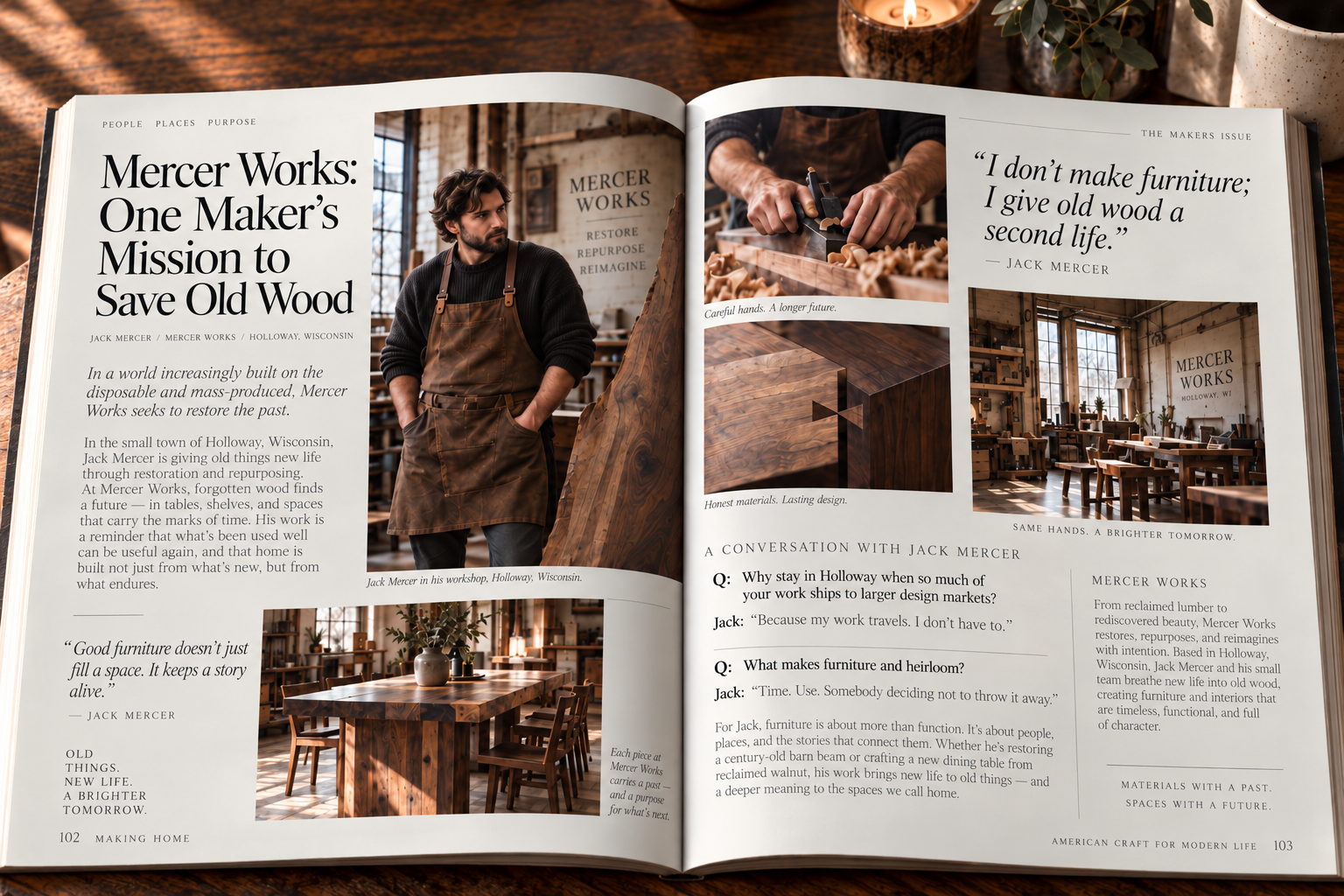
In the interview, another question:
What makes furniture an heirloom?
Jack's answer:
“Time. Use. Somebody deciding not to throw it away.”
Clara read it once.
Then looked at the box her father had labeled:
CLARA — KEEP
She laughed softly.
“Everyone's very subtle around here.”
The house said nothing.
Tomorrow:
THE FEATURE
Clara already knows her magazine wrote about Jack.
Tomorrow, she discovers what he said in the interview that never made it into print.
And for the first time, she begins to wonder whether she misunderstood more than his reasons for staying.