
Day 8 - Side B
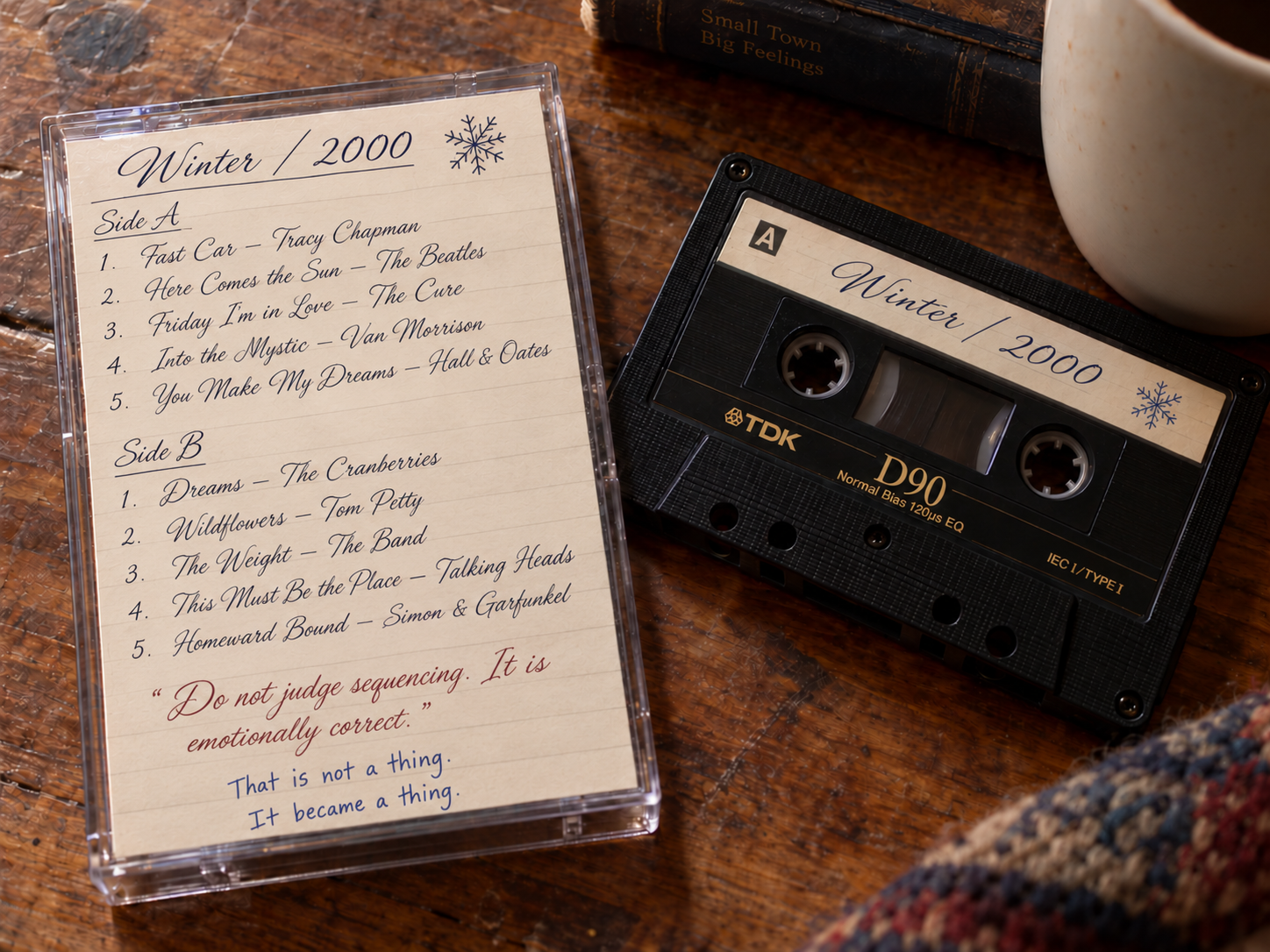
Clara found the cassette insert before she found the tape.
Naturally.
The little paper sleeve had been folded twice and tucked between two photographs in the box.
She recognized her handwriting immediately.
Large.
Certain.
Slightly slanted.
The handwriting of a woman who had not yet learned that confidence and certainty were not the same thing.
She smiled.
Do not judge sequencing. It is emotionally correct.
Underneath:
That is not a thing.
And then below that:
It became a thing.
Clara laughed.
She did not remember which one of them had added the last line.
That surprised her.
Memory was supposed to be useful.
Instead it preserved zipper pulls and pie while discarding authorship.
She carried the insert into the kitchen.
Coffee.
Laptop.
Phone.
Work.
The ordinary structure of the morning.
By nine, Clara was on a video call with her managing editor and two section leads arguing over the February cover package.
By ten, she had rejected three headline options.
By eleven, she was explaining for the fourth time that “elevated simplicity” was not a meaningful phrase.
At eleven fifteen, her phone lit up.
Jack.
You working?
She ignored it.
Professional discipline.
Three minutes later:
That means yes.
Clara muted herself.
How do you know?
You always disappeared when you were concentrating.
She stared at that.
Then:
Twenty-four years ago.
Some things are obvious.
Clara looked at the little green light beside her webcam.
Her face appeared in one corner of the screen.
Black sweater.
Hair pinned back.
Editorial Director Clara.
She typed:
I’m in a meeting.
Should I be intimidated?
Very.
Good.
She smiled.
Then unmuted herself.
“Sorry. Where were we?”
Her managing editor said, “You were killing ‘elevated simplicity.’”
“Right. It remains dead.”
At noon, Clara closed the laptop.
She looked at the cassette insert again.
Then at her phone.
Found something.
Jack replied:
Dangerous opening.
She sent him a photograph of the track list.
Three dots appeared.
Then disappeared.
Then:
Wow.
That sounds emotional.
I’m trying to recover from Side A.
The sequencing is emotionally correct.
Still not a thing.
It became a thing.
A pause.
You remembered that?
Clara smiled.
No. It’s written on the insert.
Right.
That answer felt oddly vulnerable.
Not much.
Enough.
Then Jack sent:
I still have the tape.
Clara sat up.
No you don’t.
I absolutely do.
Does it work?
Define work.
She laughed.
You kept a cassette for twenty-six years?
You kept four postcards.
Clara looked at the box.
My dad kept four postcards.
Technicality.
Then:
Want to hear it?
Clara stared at the message.
A simple invitation.
But something about music felt more intimate than coffee.
Maybe because songs were dangerous.
They carried entire rooms inside them.
She typed:
You own a cassette player?
Come to the shop and find out.
She waited twenty-seven minutes before leaving.
That felt responsible.
The workshop sounded different that day.
No machines.
No saws.
Just music playing somewhere in the back.
Modern music.
Not the tape.
Jack was at a workbench smoothing the edge of a chair seat when she walked in.
He looked up.
“Hey.”
“Hi.”
No surprise now.
That was new.
She held up the cassette insert.
“I have questions.”
“Of course you do.”
“First: why did we put ‘Homeward Bound’ at the end?”
Jack looked offended.
“That was you.”
“No.”
“Yes.”
“Absolutely not.”
“You said it was ironic.”
Clara stared.
“Oh goodness.”
“You were twenty-one.”
“That is no defense.”
“It explains a lot.”
She laughed.
Jack set the tool down.
“Come on.”
He led her toward a smaller back room she hadn't seen the first time.
Office, storage, listening space.
Shelves of books.
Material samples.
Old design magazines.
A leather chair.
And on one shelf, an actual cassette deck.
Clara stopped.
“This is absurd.”
“It works.”
“Why?”
“Because not everything improves by becoming an app.”
She looked at him.
“That is a deeply forty-eight-year-old sentence.”
“I stand by it.”
He opened a drawer.
Pulled out a clear cassette case.
Clara recognized it immediately.
Her handwriting on the side of the cassette.
WINTER / 2000
She took it from him.
“Wow.”
“Yeah.”
“Why do you have this?”
Jack leaned against the desk.
“You gave it to me.”
“I know that part.”
“Then I’m confused by the question.”
“You know what I mean.”
He nodded.
“I kept it.”
Simple.
Not sentimentalized.
Just true.
Clara turned the case over in her hand.
“Did you listen to it?”
“Sometimes.”
“Recently?”
Jack smiled.
“That feels like a trap.”
“It is.”
“Then no comment.”
Clara laughed.
He took the tape, put it into the player, and pressed play.
For a second, only hiss.
Then music.
Thin.
Warm.
Imperfect.
Clara's entire body recognized it before her mind did.
A road.
Gray winter sky.
Jack driving.
Her boots on the dashboard.
A paper cup between her knees.
The heater too high.
She closed her eyes.
And there it was.
The trip had not been planned.
That was what she remembered first.
They had been home for Christmas break, bored by the second day.
Clara wanted to get out.
Jack had access to his father's truck.
So they drove.
No destination.
Just North.
Then West.
Snow-covered highways.
Gas stations.
Bad coffee.
Music too loud.
At twenty-one, the entire world still felt reachable by car.
Clara sat sideways in the passenger seat with a map unfolded across her lap.
“Chicago,” she said.
Jack glanced over.
“What?”
“I think that’s where I’m going.”
“For lunch?”
She rolled her eyes.
“After graduation.”
Jack looked back at the road.
“Really.”
Not surprised.
Not upset.
Just absorbing it.
“I think so.”
“You have a job?”
“No.”
“Apartment?”
“No.”
“Plan?”
She folded the map.
“Why are you attacking me?”
“I’m clarifying.”
“Same thing.”
Jack smiled.
Clara looked out the window.
“I don’t need everything figured out.”
“No.”
“I just need to go.”
Jack was quiet for a moment.
Then:
“Okay.”
She turned.
“Okay?”
“Okay.”
“That’s it?”
“What do you want me to say?”
“I don’t know.”
“Congratulations?”
“No.”
“Chicago seems nice?”
“You’re being annoying.”
“I’m driving.”
“That’s not mutually exclusive.”
Jack laughed.
Then, after a moment:
“You’ll like it.”
Clara went still.
“You think?”
“Yes.”
“Why?”
“Because nobody there knows you.”
She looked at him.
He had understood.
Of course he had.
That was the part she kept forgetting.
Jack didn't mistake her wanting to leave for rejection.
Not then.
Not yet.
“You make that sound like a good thing,” she said.
“For you, it is.”
She looked back at the road.
Snow.
Bare trees.
A sky the color of steel.
“I want to be somewhere I can become somebody without everyone already deciding who I am.”
Jack nodded.
“Yeah.”
“What?”
“Nothing.”
“No, what?”
“You already said that.”
“When?”
“Ashby.”
Clara laughed.
“You remember everything.”
“No.”
“You do.”
“I remember some things.”
“Like what?”
Jack tapped the steering wheel.
“You hate raisins.”
“Correct.”
“You pretend not to care what people think, but you absolutely care.”
She glared.
“Incorrect.”
“You hate being late.”
“Everyone hates being late.”
“No. You take it personally.”
“That is a character attack.”
“You cut tags out of shirts because they bother you.”
Clara smiled despite herself.
“You’re weird.”
“You asked.”
“What else?”
Jack thought.
“You’re scared you’ll make the wrong choice and lose the version of your life you were supposed to have.”
Clara stopped smiling.
He kept his eyes on the road.
Too late.
The sentence had already landed.
“What does that even mean?”
Jack shrugged.
“You tell me.”
“I’m not scared.”
“Okay.”
“I’m not.”
“I said okay.”
“That tone means you don’t believe me.”
“I’m driving.”
“That is not an answer.”
He smiled.
Clara looked away.
She hated when he saw too much.
Loved it too.
That had always been the problem.
After a while, she said:
“If I go to Chicago, would you come?”
The question came out more casually than it felt.
Jack's hands shifted on the steering wheel.
“Maybe.”
Clara turned.
“Maybe?”
“Yeah.”
“Why maybe?”
“Because I don’t know what I’ll be doing yet.”
“So?”
“So that matters.”
“To who?”
“To me.”
She stared.
“I thought you wanted to build furniture.”
“I do.”
“You can build furniture in Chicago.”
“I know.”
“Then what’s the problem?”
“There isn’t one.”
“You’re saying maybe like there is.”
Jack exhaled.
“Clara.”
“What?”
“We’re not moving next week.”
“I know.”
“Then why are we fighting?”
“We’re not.”
“You’re making the face.”
“What face?”
“The prison one.”
Clara laughed despite herself.
“I don’t have a prison face.”
“You absolutely do.”
She looked out the window.
The conversation ended there.
Not badly.
Just unfinished.
At twenty-one, unfinished felt harmless.
They had time.
So much time.
The music stopped.
Present-day Clara opened her eyes.
The cassette clicked softly inside the deck.
Jack pressed stop.
For a while, neither spoke.
Then Clara said:
“I asked you to come.”
Jack nodded.
“I remember.”
“And you said maybe.”
“I did.”
“I remember being furious.”
“I also remember that.”
Clara smiled faintly.
“I thought you were hedging.”
“I was.”
“Why?”
Jack looked at the cassette player.
Then at her.
“Because I wanted you.”
He paused.
“And I wanted my own life.”
Clara did not answer.
Jack continued.
“I didn’t know how to say both without making one sound smaller.”
That was the kind of sentence twenty-four-old Jack would never have said.
Forty-nine-year-old Jack could.
Clara looked at him.
“I don’t think I knew how to hear both.”
“No.”
There was no accusation in it.
That mattered.
She touched the cassette case.
“Did you always think I’d go?”
“Yes.”
“Were you proud of me?”
Jack smiled.
“Annoyingly.”
“Why annoyingly?”
“Because you made it impossible not to be.”
She looked down.
The compliment embarrassed her more now than it would have then.
Maybe because now it came from someone who knew what happened after.
“I love my job,” she said.
“I know.”
“No, I really do.”
Jack nodded.
“Good.”
Clara looked up.
That was all.
Good.
No hidden disappointment.
No suggestion that success had cost her something she should regret.
Just good.
Something inside her relaxed.
She hadn't realized it had been braced.
They played the rest of the tape.
Not all at once.
They stopped to argue over sequencing.
Over who chose which song.
Over whether Jack had ever actually liked track four.
He claimed no.
Clara claimed documented evidence proved otherwise.
Theo passed the doorway once, saw them, and backed out immediately.
Clara laughed.
“What?”
Jack shook his head.
“Nothing.”
“Does he know?”
“Know what?”
She gestured vaguely.
“Us.”
Jack smiled.
“Define us.”
Clara froze.
Not because the question was romantic.
Because it was accurate.
There was no us.
Not currently.
Not yet.
Jack seemed to notice.
He softened.
“He knows who you are.”
“That sounds ominous.”
“It isn’t.”
Clara turned the cassette case over.
“Does your daughter know who I am?”
Jack hesitated.
There.
Interesting.
“Sophie? Yes.”
Clara looked up.
“How?”
Jack rubbed a thumb along the edge of the desk.
“You existed before she did.”
“That is technically true.”
“She knows I dated someone named Clara when I was young.”
“That’s all?”
“Mostly.”
Mostly.
Clara filed the word away.
“Does your your ex-wife know?”
Jack looked at her.
“Rachel? Of course.”
Of course.
The answer was so adult it made Clara almost laugh.
She had not expected jealousy.
Still, hearing the name changed the room slightly.
Rachel.
His wife.
Former wife.
Sixteen years.
Mother of his child.
An entire life Clara had not known.
Good.
That was right.
It should feel real.
She looked at the tape.
“Did you make her mixtapes?”
Jack laughed.
“CDs.”
Clara looked offended.
“Traitor.”
“It was the early 2000s.”
“Still.”
“We adapted.”
She smiled.
Good.
He had loved someone else.
So had she.
This story did not require erasing either fact.
Before she left, Clara stood in the showroom again.
The walnut table from her first visit had been moved.
In its place stood a nearly finished writing desk.
Simple.
Beautiful.
She ran her fingers along the edge.
Jack stood beside her.
“What kind of wood?”
“Ash.”
She glanced at him.
“Are you sure?”
He laughed.
“Still mad about the caption?”
“I’m professionally embarrassed.”
“You’ll recover.”
Clara looked at the desk.
“Who’s it for?”
“A writer in Chicago.”
She smiled.
“Of course.”
“Apparently there are people there who still buy handmade furniture.”
“Breaking news.”
Jack leaned against the desk.
“You know what I remember about that trip?”
“What?”
“You saying Chicago like you’d already been there.”
Clara looked at him.
“I hadn’t.”
“I know.”
“How did I say it?”
“Like it was waiting.”
She felt that.
Because it had been.
In a way.
Not fate.
Not destiny.
Just direction.
“And you?” she asked.
“What about me?”
“What did I sound like when I talked about your future?”
Jack thought.
“Like you thought it was portable.”
Clara winced.
“Fair.”
“You were twenty-one.”
“And you were twenty-two.”
“Exactly.”
They smiled.
Then Jack pulled out the cassette.
Handed it to her.
Clara frowned.
“What are you doing?”
“Take it.”
“No.”
“It was yours first.”
“You kept it.”
“So?”
“So keep it.”
Jack looked at her.
“Side B sticks.”
Clara laughed.
“That’s your argument?”
“Yes.”
“You’ve had this for twenty-six years.”
“Then it’s probably time you had it for a while.”
A while.
Not forever.
She liked that.
Clara took the tape.
“Fine.”
Jack nodded.
“Good.”
She slipped it into her coat pocket.
Beside the walnut block he had given her days earlier.
Two objects.
One old.
One new.
She noticed that.
Tried not to.
Failed.
That night, because Clara didn’t have a tape player, she put the cassette player app on her phone and tried to recreate the playlist.
It was not the same.
Of course it wasn't.
Digital clarity removed the hiss.
The transitions were too perfect.
Songs arrived without the tiny mechanical clunk between sides.
She listened anyway.
When she reached the last song, she looked at the handwritten insert again.
Homeward Bound.
Irony, apparently.
Clara smiled.
Then frowned.
Because tomorrow, she had to call the realtor.
Because she was still selling the house.
Because she was still going back to Chicago.
Because none of this changed anything.
Not yet.
She placed the cassette tape beside the postcards.
Then noticed something beneath them.
A train ticket.
She pulled it out.
HOLLOWAY → CHICAGO
Dated December 2001.
Clara stared.
That trip.
She had forgotten she kept the ticket.
No.
Not forgotten.
Buried.
There was a difference.
On the back, in her handwriting:
Next year?
And in Jack’s:
Maybe.
Clara sat very still.
There was that word again.
Tomorrow:
MERCER WORKS
Clara has now seen the workshop.
Tomorrow, she sees what Jack built with it.
And learns that six years ago, their adult lives came much closer to one another than either of them realized.