
Day 7 - The Table
Clara noticed the marks because Jack had mentioned them.
That was the only reason.
For three days she had eaten at the table.
Worked at it.
Sorted her father's paperwork across it.
Read postcards on it.
Spilled coffee on it.
And never once looked underneath.
Apparently this was how memory worked.
You could live directly above something and never know it was there.
She finished breakfast, set the provenance card beside her coffee, and crouched.
The underside of the table was darker.
Rougher.
No careful presentation.
Just wood.
She switched on her phone flashlight.
And there they were.
Pencil marks.
Faint.
Overlapping.
Years of them.
At first Clara couldn't make sense of anything.
Then she saw:
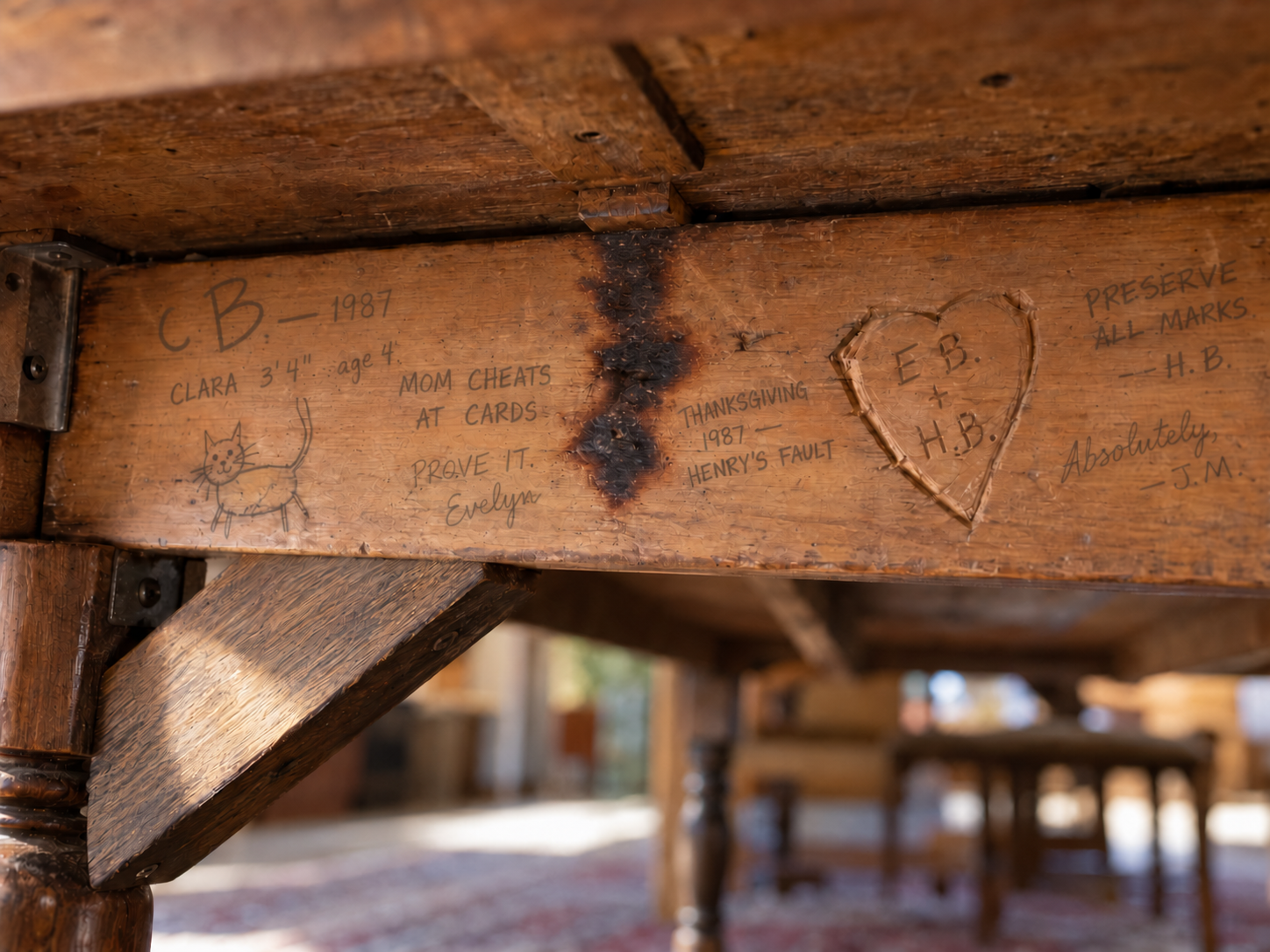
C.B. — 1987
She stopped.
Her initials.
Child-sized handwriting.
Crooked C.
Huge B.
She touched the letters.
“Oh my God.”
A separate marking beside it, from a previous date.
CLARA 3' 4"
Age beside it.
4
She laughed softly.
Her father had measured her on the underside of the dining table?
No.
Wait.
She remembered.
The table had once been pushed against the wall during a kitchen remodel.
She and her mother had crawled underneath it because the entire room was full of boxes.
Evelyn had written Clara's height there as a joke.
There were more.
A carved heart. with her parents initials
A badly drawn cat.
Someone had written:
MOM CHEATS AT CARDS
Clara covered her mouth.
That was hers.
Definitely hers.
And beneath it, in her mother's handwriting:
PROVE IT.
Clara laughed.
Then cried.
Not gracefully.
Not cinematic tears rolling neatly down one cheek.
Immediate, stupid crying while crouched underneath a dining table with her phone flashlight clenched between her teeth.
“Perfect.”
She crawled out.
Sat on the floor.
Wiped her face with the sleeve of her sweater.
Then went back under.
Because there was more.
Her father's handwriting.
Dates.
Measurements.
One line from Evelyn:
THANKSGIVING 1987 — HENRY’S FAULT.
Directly beside a dark burn mark.
Clara laughed through the tears.
And then she found something newer.
Not from childhood.
Pencil.
Small.
Neat.
Preserve all marks.
— H.B.
Below it:
Absolutely.
— J.M.
Clara stared.
Jack.
Her father had specifically asked him to keep all of it.
Every stupid pencil mark.
Every joke.
Every measurement.
The burn.
Her mother's handwriting.
None of it had been accidental.
The table was not simply old wood reused.
Henry had commissioned Jack to build around the family history.
Clara sat back on her heels.
For the first time since arriving home, grief did not feel like absence.
It felt like evidence.
She called Jack.
Not texted.
Called.
He answered on the third ring.
“Hey.”
“Why didn't you tell me?”
A pause.
“That narrows nothing down.”
“The table.”
Another pause.
Longer.
“You looked underneath.”
“Yes.”
“I figured you would eventually.”
“You preserved all of it.”
“Henry asked me to.”
“You could have told me.”
“I could've.”
“Why didn't you?”
Jack was quiet.
Clara stood in the dining room, phone pressed to her ear.
“Jack?”
“He wanted you to find it.”
That stopped her.
“What?”
“When we finished the table, I asked if he wanted me to photograph the markings and put them in the provenance record.”
“And?”
“He said no.”
Clara's throat tightened.
“He said you'd look eventually.”
She stared at the table.
“He knew I didn't know?”
“He knew you hadn't seen the finished version.”
“And he just... waited?”
“Apparently.”
Clara laughed once, incredulous.
“That is such a Dad thing to do.”
“It really is.”
She sat down.
“Did he say anything else?”
Jack hesitated.
Enough that Clara noticed.
“Yes.”
“What?”
“He said you were always in too much of a hurry to look underneath things.”
Clara closed her eyes.
“That also sounds like him.”
Jack's voice softened.
“He didn't mean it badly.”
“I know.”
“He was proud of you.”
“You keep saying that.”
“Because you keep forgetting.”
Clara went very still.
That one hit somewhere deeper.
She looked around the room.
The house.
The boxes.
The evidence of forty-sevn years.
“I think I did forget.”
Jack didn't rush to answer.
Then:
“You had a lot going on.”
“That is a very polite way of saying I was never here.”
“No.”
“Jack.”
“No.”
His tone changed.
Not harsh.
Firm.
“Don't do that.”
Clara blinked.
“Do what?”
“Turn grief into a trial where you're automatically guilty.”
She said nothing.
Jack continued.
“You lived in Chicago. You had a life. Your dad knew that. He liked that.”
“Did he?”
“Yes.”
“How would you know?”
“Because he told me.”
Clara swallowed.
Jack went quieter.
“He liked showing me your covers.”
That surprised a laugh out of her.
“My covers?”
“Every issue.”
“Oh no.”
“He kept them in a stack.”
Clara covered her eyes.
“This is mortifying.”
“He was very thorough.”
“What did he say?”
“Usually some variation of ‘She did that.’”
Clara's eyes stung again.
“Even when I didn't.”
“What?”
“I don't personally make the entire magazine.”
“Henry was fuzzy on organizational structure.”
She laughed.
“Clearly.”
Jack waited.
Then said, “You don't have to punish yourself for being loved from far away.”
Clara closed her eyes.
That sentence nearly finished her.
“Okay.”
It came out too small.
Jack seemed to know better than to say more.
After a moment, he asked:
“You want me to come by?”
Clara looked at the table.
At the pencil marks underneath.
At the boxes still waiting.
“Yes.”
The answer came before she could edit it.
Then, because she was still herself:
“But don't make it weird.”
Jack laughed.
“I'll do my best.”
He arrived forty minutes later with coffee.
Of course.
Clara opened the door.
“You're becoming predictable.”
Jack handed her a cup.
“I've known you for six days.”
“You've known me for twenty eight years.”
“Different woman.”
The words caught her off guard.
Jack seemed to realize that.
He stepped inside.
“Sorry. That sounded—”
“No.”
Clara closed the door.
“I know what you meant.”
Did she?
Maybe.
She looked at him.
Different man too.
That was becoming impossible to ignore.
They sat on the floor beneath the dining table like children.
Which was ridiculous.
Clara had moved two chairs aside.
Jack lay on his back with his hands behind his head.
“This is very dignified.”
“You built it. You knew what was under here.”
“I was younger and had functioning knees.”
“You're forty-nine.”
“Exactly.”
Clara shone her phone flashlight across the markings.
“Did Dad remember all of these?”
“Most.”
Jack pointed toward the badly drawn cat.
“He claimed that was a horse.”
“He lied.”
“I suspected.”
Clara pointed to a set of initials.
E.B. + H.B.
Inside a heart.
Jack turned his head.
“What?”
“My mother did that.”
“How do you know?”
“My dad wouldn’t have done something that romantic.”
Jack laughed.
Clara touched the heart.
“I never knew they did things like this.”
“Parents have entire lives before children arrive.”
“I know that intellectually.”
“Different from evidence.”
“Exactly.”
She looked over at him.
Their shoulders nearly touched.
Underneath a table.
This was objectively absurd.
“You know,” Clara said, “I remember thinking adults stopped changing.”
Jack smiled.
“When?”
“When we were twenty.”
“We were adults.”
“No. We had keys and opinions.”
“Fair.”
She laughed.
“I thought once you chose a career, a spouse, a house, that was basically it.”
“Roll credits.”
“Exactly.”
Jack looked at the underside of the table.
“Would've saved time.”
Clara turned toward him.
“Do you ever wish you'd left?”
He took a second.
“Holloway?”
“Yes.”
“Sometimes.”
That surprised her.
“Really?”
“Sure.”
“You always seemed so certain.”
“I was twenty-five.”
“So?”
“So I was an idiot.”
Clara laughed.
“You were very confident for an idiot.”
“You were too.”
“True.”
Jack stared upward.
“I traveled some. Did shows. Worked with a studio in Copenhagen for six months.”
Clara's head snapped toward him.
“You lived in Copenhagen?”
“Temporarily.”
“You never told me that.”
“We weren't talking.”
There it was again.
The sentence that kept revealing whole missing chapters.
“When?”
“About twenty-two years ago.”
Clara stared.
“I would've loved that.”
“I did.”
A brief pause.
“Then I came back.”
“Why?”
Jack considered.
“The shop. My parents. I missed this place.”
Clara expected the old reflex.
The part of herself that once translated I missed this place into I was afraid of more.
It didn't come.
Instead she said:
“That makes sense.”
Jack turned his head toward her.
“You would've hated that answer at twenty-three.”
“Probably.”
“You definitely would've.”
“I've improved.”
“Debatable.”
She kicked his ankle.
He smiled.
Clara went back to the markings.
“Did Dad talk about Mom much?”
“All the time.”
“Really?”
“More as he got older.”
She felt something soften.
“What did he say?”
“Nothing dramatic.”
Jack shrugged.
“Stories. Things she did. Stuff she said.”
“Like what?”
“He said she hated the dining room light fixture.”
Clara looked up.
The brass fixture still hung over them.
“She did.”
“He said you hated it too.”
“I do.”
“Then why is it still here?”
Clara looked at it.
“Because apparently we're all cowards.”
Jack laughed.
“That's definitely going on the website.”
They spent an hour going through markings.
Jack remembered which pieces Henry had insisted on saving.
Clara remembered stories attached to some.
Others were gone.
Names without context.
Dates without events.
That bothered her at first.
Then less.
Not everything had to remain decipherable to have mattered.
At one point Jack reached toward a tiny pencil mark near Clara's hand.
Their fingers touched.
Barely.
Neither moved immediately.
There.
Not lightning.
Not music.
Just warmth.
Recognition of another body.
Clara withdrew her hand first.
Not because she wanted to.
Because she noticed that she didn't.
Jack cleared his throat.
“So.”
“So.”
“This is getting less dignified.”
She laughed.
“Your knees?”
“Definitely my knees.”
They crawled out.
Jack stood first and offered his hand.
Clara took it.
He pulled her up.
Too close.
Again.
For a second, they simply stood there.
Then Jack let go.
Clara missed the contact instantly.
That was new.
And inconvenient.
They drank the rest of the coffee at the table.
Clara ran her palm over the top.
“You know what's strange?”
“What?”
“It doesn't feel old.”
Jack nodded.
“It's not.”
“But it is.”
“Also true.”
She looked at him.
“You really like contradictions.”
“I like accurate descriptions.”
Clara smiled.
“How much of the old table is actually left?”
“Maybe forty percent.”
“That little?”
“Depends how you measure it.”
“How else would you measure it?”
Jack gestured toward the table.
“If every part stayed exactly the same, it would've collapsed.”
Clara looked at him.
“So you replaced what couldn't carry weight.”
“Yes.”
“And kept what could.”
“Yes.”
She narrowed her eyes.
“You are suspiciously good at metaphors for someone who claims not to write website copy.”
Jack laughed.
“I make furniture. You're doing the metaphor part yourself.”
That was probably true.
Which was irritating.
After he left, Clara walked around the house differently.
She opened drawers.
Looked underneath things.
Checked backs of frames.
Not searching for some grand hidden message.
Just noticing.
In the china cabinet she found her mother's handwriting on the bottom of a serving platter.
Evelyn Bennett — 1978
Inside one drawer, Henry had labeled a bundle of old Christmas lights:
HALF WORK. MAYBE.
She laughed.
In the hall closet, beneath a stack of scarves, she found a small envelope.
Not sealed.
Her name on the front.
She opened it.
Inside was a photograph.
Jack's first chair.
The awful one.
He was twenty.
Standing beside it with both hands on his hips, grinning like he'd built the Taj Mahal.
Clara stood beside him.
Younger than she remembered herself.
Hair pulled up badly.
One hand on the chair.
The other pointing at Jack.
On the back, her father's handwriting:
She told him the left rear leg was wrong.
Underneath:
She was right.
Clara laughed so hard she had to sit down.
Then she looked more closely at the photograph.
At herself.
At Jack.
At the way he was looking at the camera.
At the way she was looking at him.
Not tragic.
Not doomed.
Young.
So unbelievably young.
She slipped the photograph into the box.
Beside the postcards.
Another piece.
Not because she wanted to live there again.
Because she was beginning to understand the difference between keeping the past and going back to it.
Tomorrow:
SIDE B
A cassette tape.
A handwritten track list.
A winter road trip.
And the first time Jack heard Clara say Chicago like it was already waiting for her.