
Day 4 - You Left This
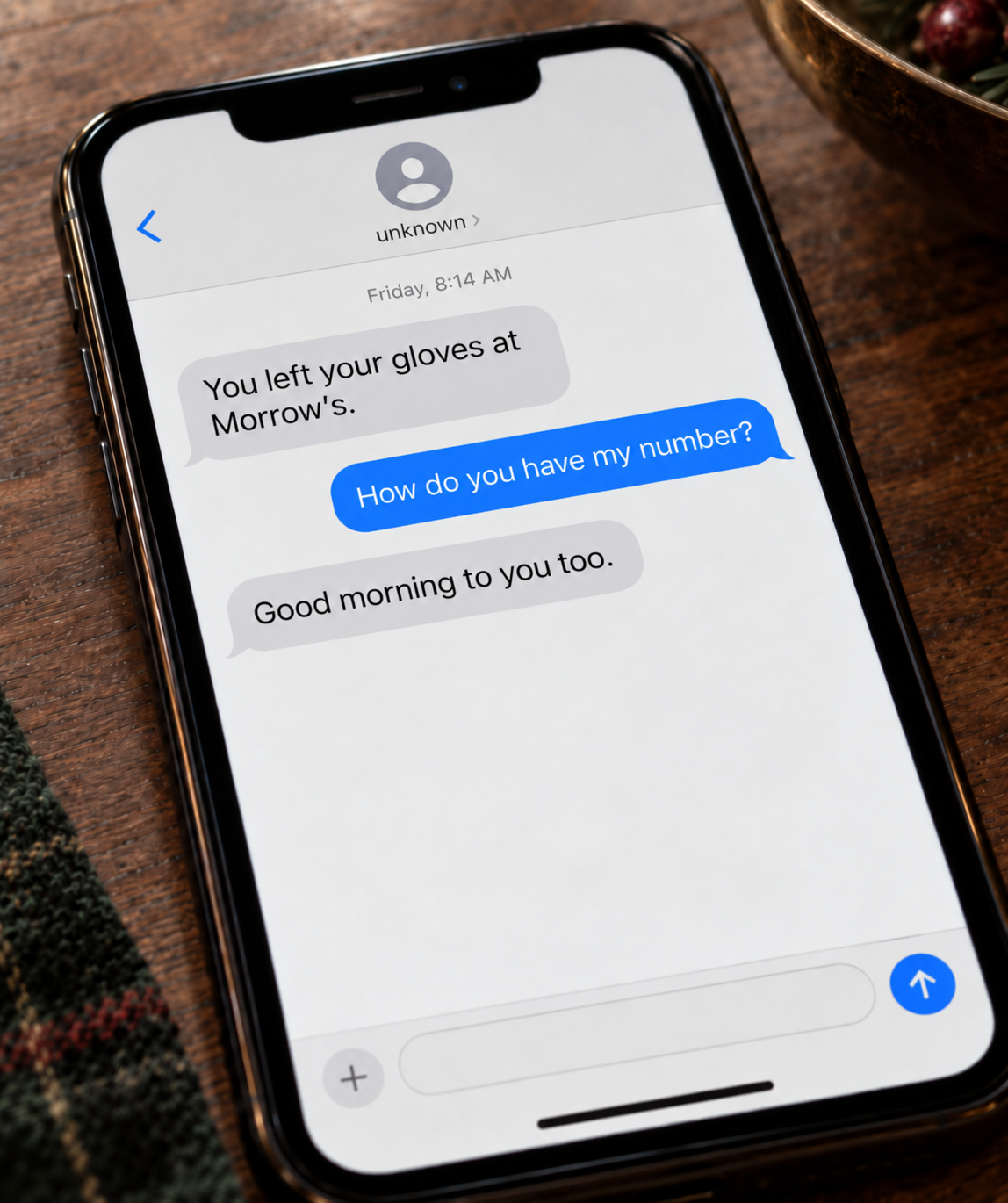
The message arrived at 8:14 on Friday morning.
Clara was standing barefoot in her father's kitchen, waiting for coffee and wondering whether a package of English muffins could legally be considered food after the expiration date had passed by fourteen months.
Her phone buzzed against the counter.
Unknown number.
She glanced at it.
You left your gloves at Morrow's.
Clara stared.
Interesting.
She unlocked the phone.
How do you have my number?
The reply appeared almost immediately.
Good morning to you too.
Clara narrowed her eyes.
There were perhaps six people on earth who could make her irritated through punctuation alone.
Apparently the list was growing.
Who is this?
Three dots.
This is going very well.
Clara smiled.
She knew.
Of course she knew.
Still, she typed:
Jack?
There we are.
She leaned against the counter.
Twenty-four years, and apparently his text messages were going to sound exactly like him.
That felt unfair.
Seriously. How do you have my number?
This time he took longer.
Henry gave it to me.
Clara's smile disappeared.
When?
A few years ago.
Why?
Another pause.
Emergency contact.
Clara stared at the screen.
Then:
For what emergency?
Furniture-related emergencies, obviously.
She laughed out loud.
Then immediately felt strange about laughing.
The house still did that to her.
Every moment of normality felt slightly disloyal.
The coffee machine sputtered behind her.
She typed:
I'm being serious.
So am I. Your dad gave it to me when I rebuilt the table. Said if anything came up and I couldn't reach him, I should call you.
Did anything come up?
No.
She waited.
Another message.
He still gave me the number.
Clara looked toward the dining room.
The table.
The provenance card.
The box.
Another small piece of her father's life that had existed without her knowledge.
Did he talk about me a lot?
She regretted sending it the second it left.
Too direct.
Too needy.
Too late to delete without making it worse.
Jack responded:
Yes.
Nothing else.
Clara stared at the single word.
Then:
Good things?
Mostly.
She smiled.
Mostly?
You apparently take too long to answer texts.
Clara looked at the screen.
Then at the time stamp.
She had taken eleven seconds.
My father did not say that.
No. That one's mine.
She laughed again.
Dangerous.
Definitely dangerous.
She found her gloves in the afternoon.
Not at Morrow's.
In the pocket of the coat she'd worn.
Clara stood in the hallway holding them.
Then looked at her phone.
She could simply say she had them.
Normal.
Efficient.
End of interaction.
Instead:
Found my gloves.
Jack responded several minutes later.
Where?
My pocket.
Strong investigative work.
I blame grief.
She stared at what she'd written.
That had come out darker than intended.
She started typing something to soften it.
Deleted it.
Then another message appeared.
Fair. Henry blamed age for losing his glasses while they were on his face.
Clara stopped.
She could see that.
Completely.
He did that constantly.
Once he made me help look for them for ten minutes.
Please tell me you eventually told him.
Eventually.
You're terrible.
He was enjoying himself.
Clara smiled.
Then:
You really knew him.
This time the pause was longer.
A little.
A little.
Not enough to threaten her place.
Not so much that it felt secret.
Somehow that answer helped.
She put the gloves back in her coat pockets.
By lunchtime, Clara had sorted three kitchen cabinets and discovered that Henry Bennett had owned eleven nearly identical spatulas.
She laid them across the counter.
“Explain yourself.”
Nothing.
She kept two.
That felt generous.
Her laptop sat open at the kitchen table with twenty-seven unread work emails.
She had promised herself she was on leave.
She had also promised her managing editor she would be available for emergencies.
The definition of emergency in publishing had historically included:
wrong headline font,
celebrity designer changing their mind,
a photographer missing a flight,
and once, a cover sofa arriving in beige instead of ivory.
Clara opened the inbox.
Two hours disappeared.
When she finally looked up, it was nearly three.
She had approved a January feature.
Rejected a cover line.
Resolved a disagreement over whether “quiet luxury” had finally become meaningless.
It had.
She shut the laptop.
For a moment she sat still.
This was the version of herself Holloway never saw.
The one who could run an editorial meeting with twelve people, edit a feature while eating lunch, and decide in fifteen seconds whether a photograph was good enough to carry six pages.
At nineteen she'd wanted a life that felt big.
Somehow, she had built one.
She loved it.
That was the inconvenient truth.
Returning home had not revealed that Chicago was false.
It had only reminded her that this had once been real too.
Her phone buzzed.
Jack.
Found something else of yours.
Clara looked at the message.
If this is another glove, I'm going to be humiliated.
Worse.
A photograph arrived.
For several seconds it didn't load.
Then it did.
Clara covered her mouth.
“Oh my gosh.”
A chair.
Technically.
One could make an argument.
It had four legs.
A seat.
A back.
The proportions were catastrophically wrong.
One rear leg angled outward like it had lost the will to participate.
The seat leaned slightly left.
Across the back, someone had written in black marker:
JACK'S FIRST CHAIR
DO NOT SIT
Clara immediately remembered.
You still have that??
Unfortunately.
I told you it looked dangerous.
You said it looked like it had been built during an earthquake.
I was supportive.
You were relentless.
And correct.
Debatable.
The chair has a warning label, Jack.
Added later.
By legal counsel?
Three dots.
By Theo after it collapsed under him.
Clara laughed so hard she had to put the phone down.
When she picked it up again:
You should have thrown it away.
Jack's response came quickly.
No.
Just that.
Clara waited.
Then:
Why not?
A minute passed.
Because it's the first thing I made that was mine.
The laughter faded.
Clara looked again at the photograph.
Not the chair.
What it represented.
Twenty-year-old Jack, building something badly because he wanted to know whether he could ever build it well.
She typed:
Okay. That's annoyingly sentimental.
Don't tell anyone.
Your reputation is safe.
Another pause.
Then:
You should come see the shop sometime.
Clara stared at the message.
There it was.
An invitation.
Casual enough to reject.
Clear enough not to misunderstand.
She did not answer immediately.
Not because she didn't want to.
Because she did.
That was newer.
At nineteen Jack had belonged to memory.
At twenty-three, to heartbreak.
At forty-seven, he had somehow become a man with a furniture studio she had never seen, a daughter she had never met, gray at his temples, and her phone number stored in his contacts because her father had given it to him years ago.
The past was becoming inconveniently current.
Clara typed:
I'd like that.
She looked at it.
Too warm?
No.
She left it.
Jack reacted with a thumbs-up. 👍
Clara frowned.
A thumbs-up.
Really?
She put the phone down.
Picked it back up.
Nothing else.
“Absolutely not.”
She returned to the kitchen.
Thirty seconds later the phone buzzed.
Tomorrow?
Clara smiled.
Better.
What time?
After lunch. Two?
Works for me.
I'll text you the address.
Clara stared at that too.
Then:
I know where the old mill is.
Of course you do.
I lived here.
Twenty-four years ago.
Rude.
Accurate.
She shook her head.
Then another message appeared.
Also, Clara?
Yes?
Wear closed-toe shoes.
She blinked.
Why?
Because it's a furniture shop.
I know what furniture is.
You've called chairs cabinets before.
Once.
Still counts.
Clara sent him an emoji she had not used professionally in her life. 🖕
Jack replied:
Looking forward to seeing you too.
She laughed.
Then froze.
She had walked directly into that.
That evening, Clara finally opened the second box of Christmas decorations.
Not because she had decided to decorate.
Because the house looked tired.
That was different.
She found one strand of lights that worked.
A small ceramic tree her mother had hated but displayed every year because someone from church had made it.
Three snowman ornaments.
A felt Santa missing an arm.
Then, she went and got the crooked gold-star ornament from the box on the dining table.
Clara held it.
She remembered that Christmas.
December 1999.
Their second.
The year Jack had come to visit her at college with almost no money and somehow believed buying a twelve-dollar artificial tree constituted responsible financial planning.
She looked at the receipt again.
MINI TREE — $12.99
STRING LIGHTS— $2.49
GLASS ORNAMENT — $0.99
GLASS ORNAMENT— $0.99
CANDY CANES — $1.49
Clara smiled.
That memory could wait.
Tomorrow belonged to the shop.
To Jack now.
She hung the gold star on the ceramic tree.
It looked ridiculous.
Perfect.
Tomorrow:
THE TWELVE-DOLLAR TREE
Before Clara sees what Jack eventually learned to build, she remembers the Christmas when neither of them had enough money to build much of anything.
One tiny apartment.
One terrible artificial tree.
Two ninety-nine-cent ornaments.
And the first time “someday” began to sound like a place they might actually reach together.