
Day 23 - The Letter That Didn’t Go
Jack arrived at eleven.
No coffee.
No toolbox.
No excuse.
Just the shoebox.
Clara opened the door and looked at it.
“That feels ominous.”
“It’s cardboard.”
“It contains twenty-four-year-old emotional material.”
“Fair.”
He stepped inside.
Neither kissed the other.
Not because anything had changed.
Because the moment seemed to ask for something quieter.
They went to the dining table.
Of course they did.
Jack placed the shoebox between them.
For a few seconds, neither touched it.
Then he opened the lid.
Clara saw the postcards.
Her handwriting.
The five pieces of a relationship preserved in paper.
Jack lifted them out.
Underneath was an envelope.
Cream.
Thin.
Her name across the front.
Clara recognized his younger handwriting immediately.
More angular.
Less controlled.
She touched the corner.
“You really stamped it.”
Jack smiled faintly.
“Apparently I was committed to the possibility.”
She turned it over.
Then saw the note.
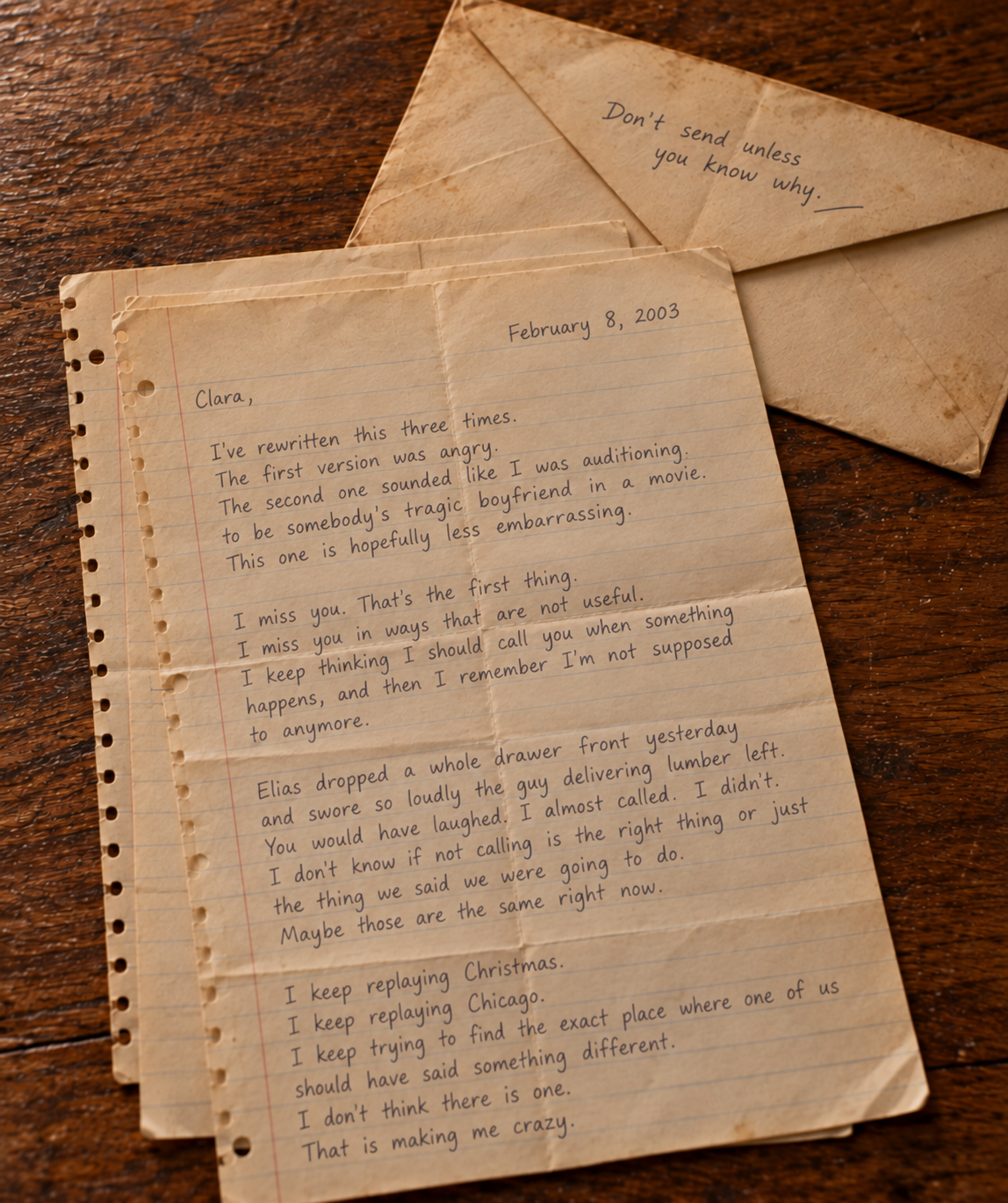
Don’t send unless you know why.
Clara looked at him.
“You wrote that?”
“Yes.”
“Why?”
Jack leaned back.
“Because I kept changing my mind.”
“About sending it?”
“Yes.”
“What finally stopped you?”
He looked at the envelope.
“I realized I wanted a response.”
Clara waited.
“And?”
“And that wasn’t fair.”
She frowned.
“Why?”
“You'd started the job. Moved into the apartment. We had ended things.”
He rubbed one hand over his jaw.
“I kept telling myself I just wanted you to know what I was thinking.”
“But?”
“But I wanted you to read it and call me.”
Clara swallowed.
“And say what?”
Jack smiled sadly.
“That you changed your mind.”
There it was.
Human.
Not noble.
Not perfectly evolved at twenty-four.
Good.
Clara looked at the envelope again.
“You didn't send it because you were protecting me?”
Jack shook his head.
“Not entirely.”
“Good.”
He looked at her.
“I was also protecting myself.”
“From?”
“You not changing your mind.”
Clara nodded.
That she understood.
Jack slid the envelope toward her.
“You can read it.”
“You don't want to?”
“I've read it.”
“Recently?”
“No.”
“How long?”
Jack thought.
“Maybe ten years.”
Clara stared.
“You haven't read your own dramatic unsent love letter in ten years?”
“I have a job.”
She laughed.
The tension cracked slightly.
Then returned.
Clara put her finger beneath the old flap.
Stopped.
“Are you sure?”
Jack looked at her.
“Yes.”
She opened it.
Inside were three sheets of lined notebook paper.
Not stationery.
Not romantic.
Folded badly.
Clara unfolded the first page.
At the top:
February 8, 2003
Then:
Clara,
She stopped breathing quite normally.
Jack stood.
“I’m going to make coffee.”
Clara looked up.
“You brought none and now you’re making it?”
“I need something to do with my hands.”
She smiled faintly.
“Fair.”
He went over to the coffee maker.
Clara began to read.
February 8, 2003
Clara,
I’ve rewritten this three times.
The first version was angry.
The second one sounded like I was auditioning to be somebody’s tragic boyfriend in a movie.
This one is hopefully less embarrassing.
I miss you.
That’s the first thing.
I miss you in ways that are not useful.
I keep thinking I should call you when something happens, and then I remember I’m not supposed to anymore.
Elias dropped a whole drawer front yesterday and swore so loudly the guy delivering lumber left.
You would have laughed.
I almost called.
I didn’t.
I don’t know if not calling is the right thing or just the thing we said we were going to do.
Maybe those are the same right now.
I keep replaying Christmas.
I keep replaying Chicago.
I keep trying to find the exact place where one of us should have said something different.
I don’t think there is one.
That is making me crazy.
It would be easier if you had done something awful.
It would probably be easier if I had.
But you didn’t.
And I didn’t.
We just wanted things.
I’m still mad at you.
I assume you’re still mad at me.
I’m also proud of you.
That part is inconvenient.
I bought your magazine yesterday even though your name isn’t in it yet.
I know that’s stupid.
I wanted to see what you’re seeing every day.
I tried to picture you there.
I can.
That might be the worst part.
You fit.
I think I expected Chicago to look wrong on you so I could feel right.
It doesn’t.
I’m glad.
I hate that I’m glad.
I’m sorry for making staying here sound like something you should want if you loved me.
I knew better.
At least part of me did.
I also think you made leaving sound like the only brave thing a person could do.
Maybe we were both trying to make the other person’s choice smaller so ours wouldn’t feel selfish.
I don’t know.
I’m getting tired of deciding which one of us was right.
Maybe that was the wrong question.
Maybe the question wasn’t:
Who loves who enough to go?
Or:
Who loves who enough to stay?
Maybe it was:
Can we love each other and still want different lives?
I think the answer was yes.
I just don’t know what we were supposed to do with that.
I wish I had.
I keep imagining versions where we figure it out.
You come home some weekends.
I come to Chicago.
There’s a train.
There are phones.
People do this.
Then I imagine both of us spending every visit trying to convince the other person to eventually give in.
That doesn’t feel like love either.
It feels like waiting.
I don’t want you waiting for me to become someone who wants your life.
And I don’t want to spend mine waiting for you to decide mine was enough.
That sentence sounds angry.
I’m not trying to be.
I think what I mean is that I want you to have the life you keep talking about without needing to apologize to me for it.
And I want to build mine without pretending I’m only here because I was afraid to go.
Maybe someday we’ll both understand that.
Maybe we won’t.
I don’t know why I’m writing this if I’m not going to send it.
Maybe because saying “I love you” on the phone before we hung up wasn’t enough.
So:
I love you.
I’m still in love with you.
I don’t know when that stops.
I suppose it does.
People survive worse things.
But I don't want the last thing you remember about us to be the argument.
You were my best friend for five years.
You believed I could make things before I had made anything worth keeping.
You gave me that black notebook.
I’m using it.
You were right about the back leg of the chair.
Do not become unbearable about this.
I hope your apartment gets warmer.
I hope your boss realizes how good you are.
I hope someday you have an office with a door and people have to knock before coming in.
I hope you get to make something that feels like yours.
I hope I do too.
I don’t know if we were supposed to stay together.
I don’t know if people are supposed to do anything.
I just know I’m glad it was you.
Even if this is it.
Especially if this is it.
I love you.
Jack
P.S. The song was still terrible.
Clara finished.
Then did not move.
The house made its ordinary sounds.
Heat through old vents.
A refrigerator motor.
Jack in the kitchen doing a remarkably poor job of pretending he wasn't waiting.
Clara read the last paragraph again.
Then the middle.
Then one sentence:
Maybe we were both trying to make the other person’s choice smaller so ours wouldn’t feel selfish.
“Damn you,” she whispered.
From the kitchen:
“What?”
“Nothing.”
She wiped her face.
That was when Jack came back.
Two mugs.
He saw her.
Stopped.
“I warned you.”
Clara laughed through the tears.
“You absolutely did not warn me enough.”
He put the coffee down.
Sat across from her.
For a while, Clara said nothing.
Jack didn't ask.
That was good.
She needed to find the right question.
Twenty-four years ago, apparently neither of them had been very good at those.
Finally:
“Why did you keep it?”
Jack looked at the letter.
“I don't know.”
“That answer remains unacceptable.”
He smiled faintly.
Then considered.
“Because throwing it away felt like pretending I hadn't felt it.”
Clara nodded.
That made sense.
“Did Rachel know?”
“About the letter?”
“Yes.”
Jack nodded.
Clara blinked.
“She knew?”
“Yes.”
“Did she read it?”
“No.”
“Why not?”
“She never asked.”
Clara sat back.
“You told your wife you kept an unsent letter to your ex-girlfriend?”
“It came up when we moved.”
Clara laughed.
“I need more context.”
“She found the box.”
“And?”
“I told her what was in it.”
“And she was just fine with that?”
Jack smiled.
“Rachel didn't require me to arrive in our marriage without a history.”
There it was again.
An emotionally healthy sentence Clara found almost irritating.
“Your ex-wife is ruining my ability to feel superior.”
“I'll let her know.”
Clara laughed.
Then looked at the letter.
“You really loved her.”
“Yes.”
No hesitation.
Clara smiled.
“Good.”
Jack looked at her.
“You keep saying that.”
“Because I mean it.”
“I know.”
She folded the first page carefully.
Then stopped.
“Jack.”
“Yeah?”
“If you had sent this…”
He waited.
“Would I have changed my mind?”
That was not what she meant.
She corrected herself.
“No. Wrong question.”
Jack smiled slightly.
Clara looked at the letter.
“If you had sent it, do you think we would have gotten back together?”
He thought.
“Maybe for a while.”
Clara looked up.
That was not the romantic answer.
It was probably the true one.
“I think so too.”
“We were still the same people.”
“Yes.”
“Same jobs.”
“Same cities.”
“Same argument.”
Clara nodded.
“The letter understood things we didn't know how to live yet.”
Jack looked at her.
“That’s probably fair.”
She smiled faintly.
“It annoys me that twenty-four-year-old you wrote some of this.”
“Why?”
“He was more insightful on paper.”
“Always have been.”
“Not a compliment.”
“I know.”
Clara picked up the letter again.
“You wrote that you hoped I'd have an office with a door.”
Jack smiled.
“Do you?”
“Yes.”
“People knock?”
“Not enough.”
“Still counts.”
She laughed.
“And you hoped you'd make something that felt like yours.”
Jack looked toward the table.
Toward the provenance card.
The shop across town.
The whole life around him.
“I did.”
“Yes.”
They had.
Both of them.
The letter was full of wishes already granted.
Not together.
That did not make them failures.
Clara felt something break open then.
Not grief.
Release.
For years she had thought the tragedy was that they had loved each other and still separated.
Maybe she had it backward.
Maybe the remarkable thing was that they had loved each other enough—eventually, clumsily—to stop demanding that one person abandon themselves so the relationship could survive.
Their younger selves had not known how to call that love.
Their older selves could.
“Can I ask you something terrible?” Clara said.
Jack smiled.
“You've never needed permission before.”
“Do you think part of you kept this because you thought maybe someday—”
“No.”
The answer came immediately.
Clara stopped.
Jack softened.
“Not after a while.”
She appreciated the distinction.
“At first?”
“Yes.”
“Okay.”
“For the first year, probably.”
She nodded.
“Then life happened.”
“Yes.”
“Rachel.”
“Yes.”
“Sophie.”
His face changed at her name.
Warm.
“Yes.”
“The shop.”
“Yes.”
Jack looked at the letter.
“It stopped being a possibility and became a thing that happened to me.”
Clara swallowed.
“A thing worth keeping.”
“Yes.”
Not a plan.
Not a promise.
History.
Exactly.
Jack reached for the pages.
Clara held them back.
“Not yet.”
He raised an eyebrow.
She smiled.
“I'd like to read it once more.”
“Okay.”
She did.
Slowly this time.
The humor.
The anger.
The longing.
The young man trying desperately to understand a heartbreak that did not contain a villain.
When she reached:
I hope you get to make something that feels like yours.
she stopped.
Then looked at Jack.
“You did that too.”
“What?”
“Believed I could make something before I had.”
He smiled.
“Yeah.”
Clara folded the pages carefully.
Placed them back in the envelope.
Then handed it to him.
Jack did not take it.
“Keep it.”
Clara shook her head.
“No.”
“It was written to you.”
“But it was yours.”
“It was supposed to be yours.”
“No.”
She pushed it toward him.
“You made the right decision.”
Jack looked confused.
“Not sending it.”
Clara smiled sadly.
“I think you made the right decision.”
He looked at the envelope.
Then at her.
“You’re sure?”
“Yes.”
She tapped it.
“That belongs to the person who needed to write it.”
Jack finally took it.
“Okay.”
Clara felt unexpectedly good about that.
Not everything from the past needed to migrate into her box.
Some things could remain with him.
Two archives.
Still separate.
They spent the afternoon together.
Nothing dramatic.
Jack helped her pack books.
Clara found an old yearbook.
They mocked hairstyles.
He discovered she had received “Most Likely to Leave Wisconsin.”
Clara stared at the page.
“You have got to be kidding me.”
Jack laughed so hard he had to sit down.
“This is unbelievable.”
“I forgot.”
“Of course you did.”
She pointed at his picture.
“You got ‘Best Hair.’”
“I earned it.”
“You had curtains.”
“They were excellent curtains.”
“They were criminal.”
For twenty minutes the past became funny again.
Clara needed that.
The letter did not swallow the day.
Nothing did.
At four, Jack carried boxes to the garage.
Clara's phone rang.
Daniel from work.
She answered.
Jack kept packing.
She spent fifteen minutes resolving a scheduling issue for January.
When she hung up, Jack was labeling a box:
CLARA — BOOKS / CHICAGO
She stared.
“What?”
Jack looked at the label.
“Too soon?”
“No.”
She walked closer.
Chicago.
Her life.
Still there.
Still hers.
She kissed him.
No speech.
Just because she wanted to.
Jack put the marker down.
“Hi.”
“Hi.”
“What was that for?”
Clara thought.
“The box.”
“The box?”
“It says Chicago.”
“Yes.”
“You didn't make it weird.”
Jack smiled.
“I’m learning.”
“So am I.”
That evening, they ordered pizza.
Sitting on the floor because Clara had begun wrapping dining chairs for the move.
The house looked different now.
Actually in transition.
Not memorial.
Not temporary vacation.
Leaving.
Jack looked around.
“It’s getting empty.”
Clara nodded.
“Yes.”
“You okay?”
She considered.
“No.”
Then:
“Also yes.”
Jack nodded.
Both.
Always both.
Clara took another slice.
Then asked:
“What do you think the letter means now?”
Jack looked at her.
“Nothing.”
She blinked.
“Nothing?”
“Not nothing-nothing.”
“Excellent clarification.”
He smiled.
“I mean I don't think it gets to mean something about us now.”
Clara went quiet.
That was exactly right.
“It meant something then.”
“Yes.”
“And now?”
“Now we're sitting on the floor eating pizza.”
Clara smiled.
“Romantic.”
“Very.”
He took a drink.
“The letter doesn't get to decide whether we work.”
“No.”
“Our old relationship doesn't either.”
“No.”
Jack looked at her.
“We do.”
Present tense.
Clara held his gaze.
“Yes.”
There it was.
The thing they had not understood when young.
They did not need proof from the past.
They needed choices in the present.
Repeated choices.
Maybe that was all any relationship ever had.
Later, Jack left.
Clara stood at the window watching his truck disappear.
She did not feel abandoned.
She did not feel reunited.
She felt something quieter.
Ready.
Not for a move.
Not for forever.
For the next honest thing.
She returned to the dining room.
The box was nearly packed.
The postcards.
The train ticket.
The recipe card.
Photographs.
Cassette.
All the old artifacts.
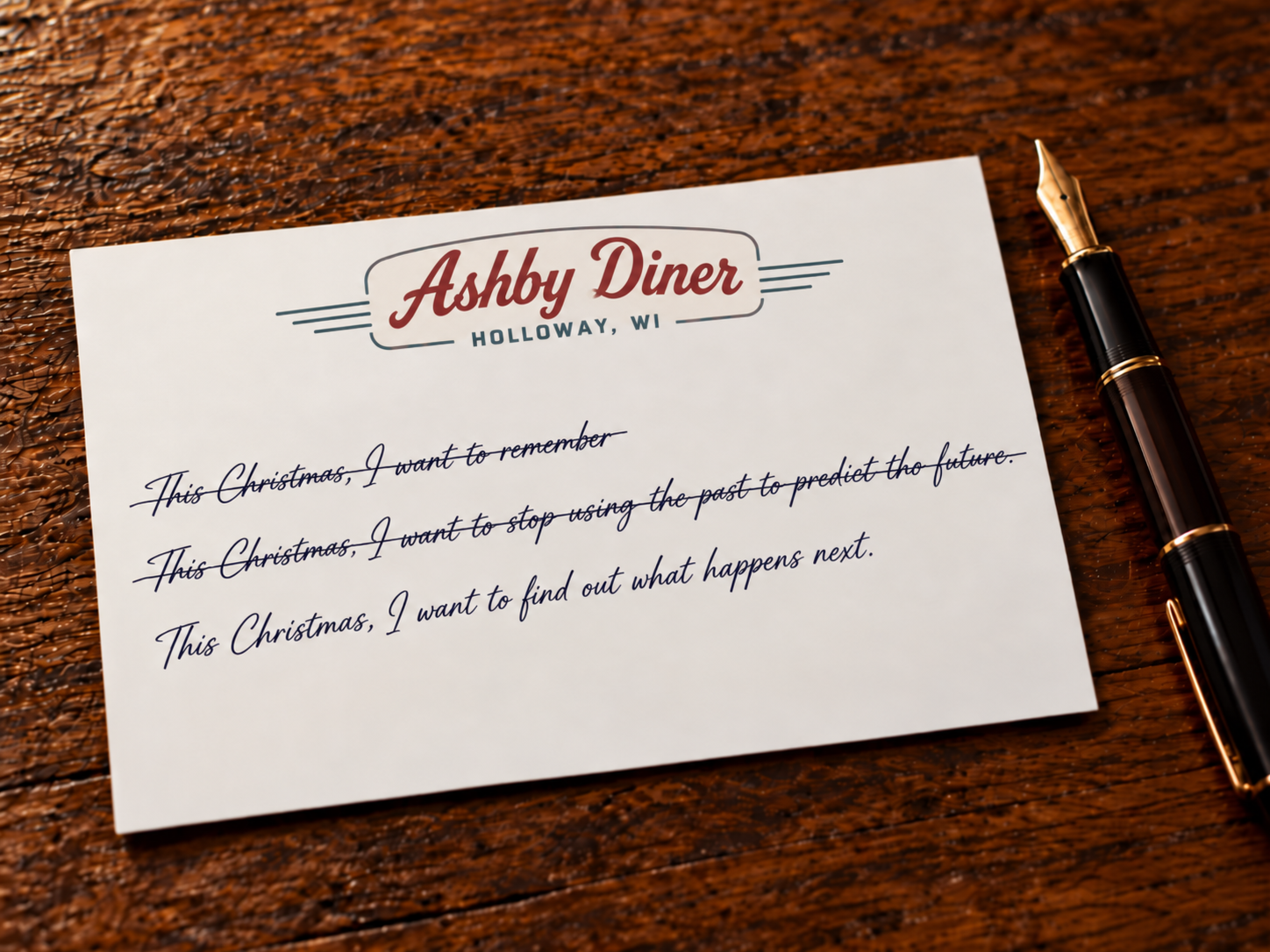
Clara took out a blank postcard she had bought at the Ashby.
The new print.
Same diner.
Different image.
She turned it over.
For the first time in twenty-four years, she began the old sentence.
This Christmas, I want to remember...
Then stopped.
She smiled.
Crossed it out.
Below it, she wrote:
This Christmas, I want to stop using the past to predict the future.
She looked at it.
Too editorial.
She crossed that out too.
Third attempt:
This Christmas, I want to find out what happens next.
Clara stopped.
There.
That one.
She did not sign it.
Not yet.
Tomorrow:
WHAT HAPPENS NEXT
Twenty-four years ago, Clara and Jack asked each other to choose.
Tomorrow, neither will.
There will be no proposal.
No dramatic move.
No promise that distance will be easy.
Just one new postcard.
One changed flight.
And two people deciding that they do not need to know the ending before they begin.