
Day 17 - If You Loved Me
Clara did not see Jack the next morning.
That was probably wise.
She had fallen asleep sometime after one with his last text still open on her phone.
I’m trying not to plan your answer for you.
Annoyingly mature.
Annoyingly attractive.
Annoying in general.
She made coffee.
Worked.
Answered emails.
Reviewed proofs.
Changed three headlines.
Approved a photograph.
Normal life.
At noon, she went downstairs and opened the box.
The final postcard waited near the bottom.
She hadn’t realized it was there.
She unknowingly touched the edge of it more than once.
Never pulled it free.
She had missed recognizing it because it hadn’t been tied in the thin red string with the others.
She recognized it now.
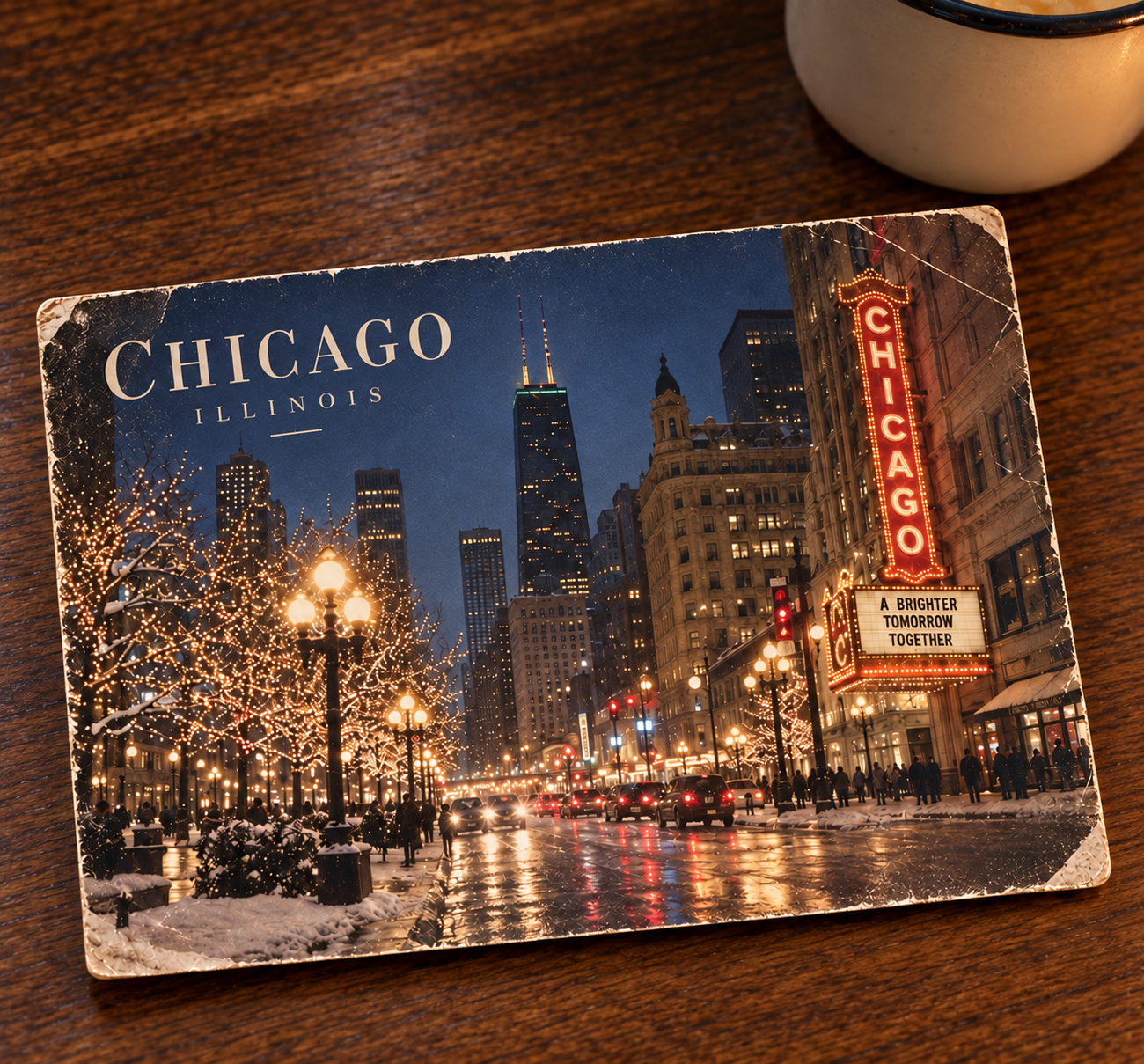
Chicago at night.
December 2002..
Her last postcard to Jack lay elsewhere, in his shoebox.
This one was his.
The last he had actually mailed.
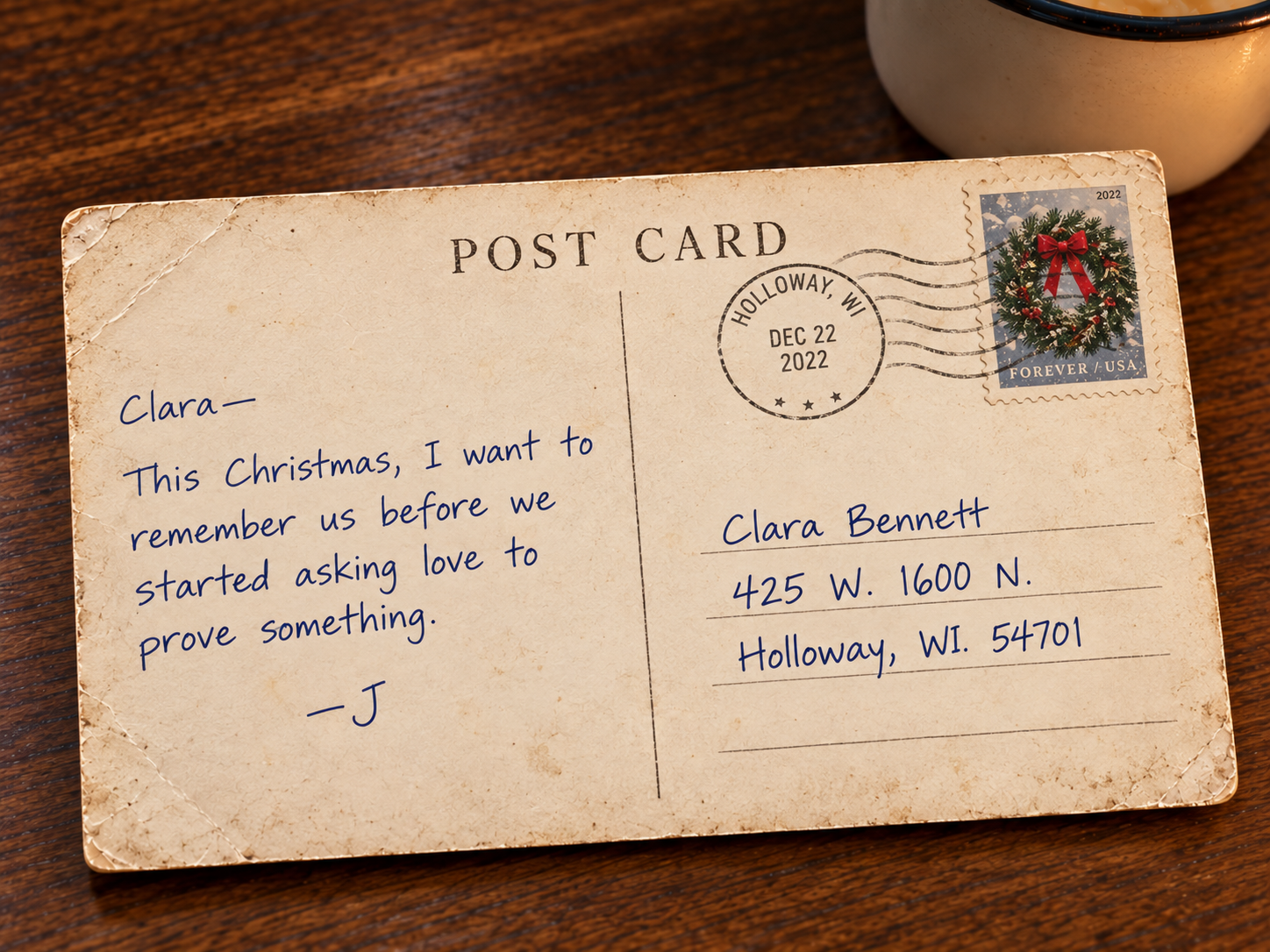
Clara turned it over.
This Christmas, I want to remember us before we started asking love to prove something.
That was all.
No joke.
No sign-off beyond:
—J
She read it twice.
Then sat down.
For sixteen days, memory had become softer.
Complicated.
Generous.
This was not soft.
This was a door.
And Clara already knew what was behind it.
Christmas Eve 2002 was not dramatic at first.
That was the cruel part.
There was dinner at her parents’ house.
Evelyn made too much food.
Henry burned one tray of rolls and blamed the oven.
Jack arrived late because Elias had kept him at the shop.
Clara noticed.
Of course she noticed.
He kissed her in the hallway.
She kissed him back.
Still in love.
Still angry.
Still afraid.
All three things could apparently occupy the same body.
By dessert, Clara had answered three questions about Chicago from relatives.
When was she moving?
Had she found an apartment?
Was Jack going too?
That last one kept arriving in different forms.
Evelyn shut one aunt down with a look.
Henry changed the subject.
Jack smiled politely.
Clara kept answering:
“We’re figuring it out.”
We.
Always we.
But the word had begun to feel aspirational.
After dinner, everyone migrated toward the living room.
Jack stayed behind to help clear dishes.
Clara followed.
For several minutes they worked in silence.
Plates.
Glasses.
Silverware.
Ordinary tasks.
Then Clara said:
“Have you decided?”
Jack did not pretend not to understand.
“Not completely.”
She closed her eyes.
“Jack.”
“I know.”
“No. I don’t think you do.”
He put a plate down.
“Then tell me.”
“I start January twelfth.”
“I know.”
“I need to move.”
“I know.”
“I found an apartment.”
Jack looked at her.
“You did?”
There.
That tiny reaction.
Hurt.
She immediately became defensive.
“I had to.”
“You didn’t tell me.”
“I’m telling you now.”
“When did you find it?”
“Yesterday.”
“And signed?”
She hesitated.
“Today.”
Jack looked away.
That hurt too.
“You signed a lease.”
“I need somewhere to live.”
“I understand how apartments work.”
“Then why are you acting like this?”
“I’m not.”
“You are.”
“Clara.”
“You still haven’t told me what you’re doing.”
“I’m trying to figure it out.”
“No, you’re avoiding it.”
Jack exhaled.
“Fine.”
He dried his hands on a towel.
“I’m taking Elias’s offer.”
There it was.
Simple.
Final.
Clara went still.
“You already decided.”
“Yes.”
“How long have you known?”
“A few days.”
She laughed once.
Not because anything was funny.
“So you were waiting until when?”
“I don’t know.”
“After Christmas?”
“Maybe.”
“Gosh, that word.”
“Clara.”
“No. Seriously. Maybe. Later. We’ll see. You never actually say what you want until there’s no room left to talk about it.”
Jack’s jaw tightened.
“That’s fair.”
The admission only made her angrier.
“And now?”
“I want the shop.”
The honesty landed hard.
Clara crossed her arms.
“And me?”
Jack looked at her.
“You know I want you.”
“No. That is exactly the problem.”
He stared.
“What does that mean?”
“It means you keep saying you want me while choosing a life that has no room for me.”
Jack’s expression changed.
“My life has room for you.”
“Where?”
“What?”
“Where, Jack?”
She was louder now.
Not shouting.
Close.
“In the little house? At the desk you drew for me?”
His face changed again.
She regretted it immediately.
Too late.
“That’s not fair.”
“No?”
“You made an entire list of jobs for me in Chicago.”
“At least there are jobs.”
“There are jobs here.”
“For me?”
“You could write anywhere.”
Clara laughed.
That was the wrong answer.
He knew it as soon as he said it.
“My job is not ‘writing anywhere.’”
“I know.”
“No, you don’t.”
“I do.”
“Then stop treating it like something I can pack into a spare bedroom.”
Jack rubbed both hands over his face.
“I’m trying to find a version where this works.”
“So am I.”
“No, you’re trying to find a version where I come with you.”
Clara went silent.
Because yes.
That was true.
He continued.
“And I’m trying to find one where you stay.”
There it was.
Equal guilt.
Clara looked down.
For one second, they were both simply tired.
Then she said:
“I can’t stay.”
Jack nodded.
“I know.”
“Then what are we doing?”
“I don’t know.”
The answer broke something.
Not because it was careless.
Because she had been waiting for him to know.
Clara's eyes filled with tears.
She hated that.
“Do you love me?”
Jack stared at her.
“What kind of question is that?”
“Answer it.”
“Yes.”
“Then why is this so hard?”
Jack’s face tightened.
“Because loving you doesn’t magically make me want your life.”
The kitchen went silent.
That sentence.
The true one.
The impossible one.
Clara felt it like rejection even though it wasn't.
“So that’s it.”
“No.”
“What else is there?”
“Plenty.”
“Like what?”
“Me loving you.”
“Apparently not enough.”
Jack went still.
Clara knew.
Even before he spoke.
She had crossed the line.
“If I loved you enough?”
His voice was quiet.
Clara said nothing.
Jack looked at her.
“That’s what you mean.”
“No.”
“Yes.”
“That isn’t—”
“It is.”
He took a step back.
“You think if I loved you enough, I’d go.”
Clara’s throat tightened.
“And you think if I loved you enough, I’d stay.”
Jack stopped.
There.
The mirror.
Neither could escape it.
Clara wiped at one eye.
“Maybe.”
Jack laughed softly.
Broken.
“Damn it.”
“What?”
“We’re doing the exact same thing.”
She looked at him.
He was right.
That did not make it less painful.
Jack leaned against the counter.
“I don’t want to ask you to give up Chicago.”
“But you want me here.”
“Yes.”
“I don’t want to ask you to give up Elias.”
“But you want me there.”
“Yes.”
They stood inside the impossible symmetry of it.
Then Clara said the sentence anyway.
“Maybe if you loved me enough, you’d at least try.”
Jack closed his eyes.
And when he opened them, there was hurt.
Not anger.
Worse.
He nodded once.
“Maybe if you loved me enough, you wouldn’t need me to.”
Clara stopped breathing.
There it was.
Both versions.
Spoken.
Impossible to take back.
For several seconds neither moved.
Then Jack said:
“That was awful.”
Clara nodded.
“Yes.”
“I’m sorry.”
“Me too.”
But apology did not undo meaning.
Not when the meaning had been living underneath everything for months.
They did not break up that night.
That was another part Clara had simplified.
There was no door slam.
No dramatic exit into snow.
They finished cleaning the kitchen.
Because Evelyn came in.
Because life continued.
Jack stayed another hour.
They exchanged gifts with Clara’s parents.
They sat close but not touching.
When he left, Clara walked him outside.
Cold air.
Porch light.
Everything ordinary.
Jack put his hands in his coat pockets.
“I don’t want this to be over.”
Clara felt tears again.
“Neither do I.”
He looked at her.
“Then what do we do?”
Clara had spent years believing there was always a plan if you worked hard enough.
For once, she had none.
“I don’t know.”
Jack almost smiled.
“Careful.”
She laughed through the tears.
That made it worse.
He kissed her forehead.
Not her lips.
Then he left.
They lasted another three weeks.
Calls.
Arguments.
Apologies.
Plans.
Alternate plans.
A suggestion that Jack comes out on weekends.
A suggestion that Clara delay the job.
A suggestion that they try long-distance.
A weekend in Chicago that ended badly.
A weekend in Holloway that ended worse.
Nothing was catastrophic.
That was the tragedy.
No betrayal.
No one stopped loving the other.
They simply kept trying to solve the same equation with the same two answers.
Eventually, one night in January, Clara sat on the floor of her new Chicago apartment surrounded by boxes.
Jack was on the phone.
He had started at Porter full-time.
Clara had started at the magazine.
Both were exhausted.
Both were missing each other.
Both were becoming increasingly cruel in small ways.
Finally Jack said:
“I don’t want to start hating you.”
Clara closed her eyes.
“I don’t either.”
The silence lasted a long time.
Then she said:
“So what are we saying?”
Jack breathed out.
“I think we’re saying stop.”
Clara covered her mouth.
She did not want to agree.
She did.
“Okay.”
“Okay?”
“Don’t make me say it twice.”
“I won’t.”
They both cried.
Clara hated remembering that.
Not because crying embarrassed her.
Because grief had been so clean then.
No one had died.
No one had betrayed anyone.
And still something ended.
Before they hung up, Jack said:
“I love you.”
Clara answered:
“I love you too.”
Neither said:
forever.
Neither said:
maybe someday.
That would have been easier.
They simply ended with the truth.
Present-day Clara realized she was crying only when a tear landed on the postcard.
She pulled it back quickly.
“Shit.”
Blotted the corner.
No damage.
Of course that was her first concern.
Preserve the artifact.
She laughed at herself.
Then picked up her phone.
She stared at Jack’s name.
Did not call.
Not yet.
Instead, she went for a walk.
Holloway was gray that afternoon.
Not charming.
Slush along the curb.
Salt whitening the sidewalks.
Clara walked without destination.
Past Morrow Hardware.
Past North & Main.
Past the old Regent.
When she reached the river, she stopped.
The mill stood across the water.
Mercer Works.
Jack was somewhere inside.
Probably working.
Building something.
Living the life he had once chosen.
And Clara loved that for him.
That realization surprised her less than it once would have.
She loved her life too.
That was the part young Clara and Jack could not understand:
Sometimes the thing standing between two people was not a wrong choice.
Sometimes it was two right ones.
Her phone buzzed.
Jack.
You okay?
Clara stared.
How did he—
Then remembered.
Of course.
They had not spoken all day.
Maybe he was simply checking.
She typed:
I read the last postcard.
A long pause.
Then:
I wondered if you would.
I remember the kitchen.
No response for nearly a minute.
Then:
So do I.
Clara leaned against the railing.
We were awful.
We were scared.
She smiled sadly.
Both.
Then:
Do you regret saying it?
Jack called.
She answered.
Neither said hello.
He said:
“Yes.”
Clara looked at the river.
“Me too.”
“But I don’t regret that it was true.”
She closed her eyes.
There it was.
The grown-up answer.
“I know.”
“I did think you should want to stay if you loved me enough.”
“And I thought you should want to go.”
“Yes.”
Clara watched ice move slowly along the edge of the river.
“I hate that we did that to each other.”
“Me too.”
A pause.
Then Jack said:
“But I’m glad we didn’t.”
Clara frowned.
“What?”
“Give in.”
She went still.
Jack continued.
“If you’d stayed because of me, you would’ve resented me eventually.”
“Yes.”
“If I’d gone because of you, I might’ve resented you.”
“Yes.”
“We were terrible at getting there.”
Clara laughed softly.
“But maybe we got the decision right.”
That sentence landed harder than she expected.
Because yes.
Maybe they had.
She had spent years mourning the relationship without regretting Chicago.
Those facts were allowed to coexist.
Clara asked:
“Do you think that means we weren’t supposed to be together?”
Jack laughed softly.
“That question sounds suspiciously unlike you.”
“It does.”
“You believe in editorial deadlines, not destiny.”
“Correct.”
“I don’t think anything was supposed to happen.”
Clara smiled.
“Good answer.”
“I think we made the best decision we knew how to make.”
She nodded.
Then:
“And now?”
The question escaped.
Not historical.
Not theoretical.
Now.
Jack went quiet.
Clara immediately wanted to take it back.
Then he said:
“I don’t know yet.”
Twenty-four years ago, that answer would have terrified her.
Today, Clara smiled.
“Okay.”
Jack heard it.
“You’re not mad?”
“No.”
“Growth.”
“Don’t ruin it.”
He laughed.
Then:
“Dinner tomorrow?”
Clara looked across the river toward the mill.
“Yes.”
A pause.
“Date?”
She smiled.
“Yes.”
Clear answer.
No maybe.
Jack said:
“Good.”
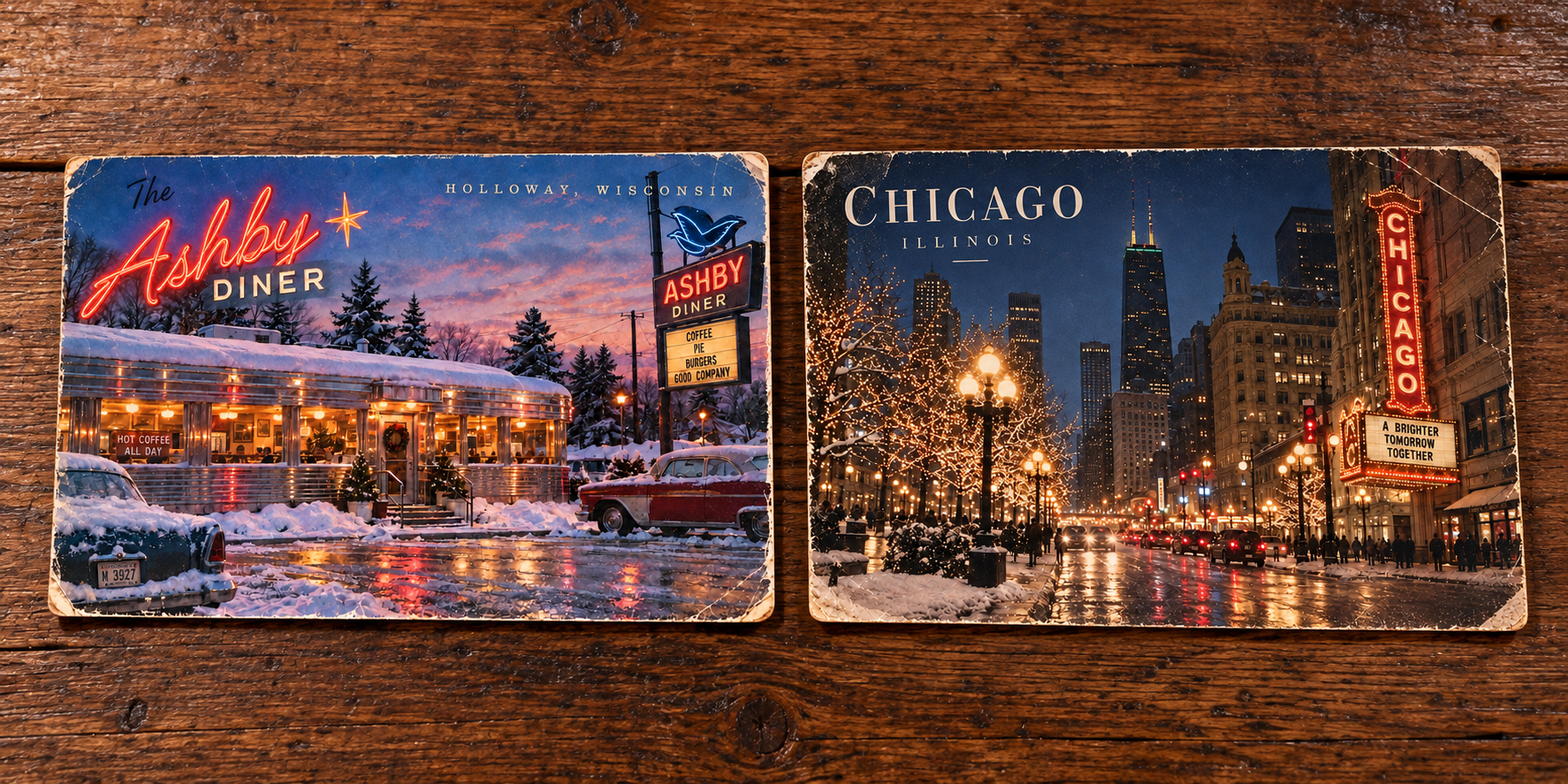
That night, Clara placed the final postcard beside the first.
1998
2002
One beginning.
One ending.
She expected sadness.
It was there.
But something else had joined it.
Gratitude.
They had loved each other.
Badly sometimes.
Beautifully often.
And when loving each other began requiring one of them to become smaller, they had eventually stopped.
Maybe that was not failure.
Maybe it had been the first grown-up thing they ever did.
Tomorrow:
OTHER CHRISTMASES
The story did not stop when Clara and Jack did.
There were weddings.
Children.
Careers.
Houses.
People they loved.
Tomorrow, Clara and Jack finally talk about the twenty-four years between them—not as lost time, but as lives worth having.