
Day 16 - Your Plan For Me
Clara woke up angry with herself.
Not devastated.
Not heartbroken.
Annoyed.
There was something particularly irritating about discovering your younger self had been wrong in a way you could no longer correct.
No apology could reach twenty-three.
No conversation could be rerun.
No thoughtful adult perspective could be inserted retroactively into a hotel room in Chicago.
The past remained aggressively closed to revision.
Clara disliked that.
Editors were not trained for uneditable material.
She was halfway through coffee when Naomi called.
“You sound angry.”
“I said hello.”
“You have an angry hello.”
“I found my Chicago list.”
“Oh.”
“And Jack showed me his sketch.”
“The tiny house?”
“You know about the tiny house?”
“Clara, I knew you in 2002.”
“Apparently everyone had more information than I did.”
Naomi laughed.
“What are you mad about?”
“Myself.”
“Boring.”
“Thank you.”
“You were twenty-three.”
“I am banning that sentence.”
“It remains relevant.”
Clara walked into the dining room.
Her legal pad lay on the table.
“I wrote his future like a project plan.”
“Yes.”
“I listed jobs for him.”
“Yes.”
“I put ‘update portfolio’ like I was his manager.”
“Yes.”
“You're enjoying this.”
“A little.”
Clara sat down.
“The worst part is that I thought I was being supportive.”
“You were being supportive.”
“That is not supportive.”
Naomi softened.
“It was. Just incomplete.”
Clara frowned.
“What does that mean?”
“It means you were trying to help him have the life you thought would make both of you happy.”
“Exactly.”
“That’s loving.”
Clara waited.
“And controlling,” Naomi added.
“There it is.”
“Both can be true.”
“I hate that phrase.”
“I know.”
Clara looked at the list again.
“So where’s the line?”
“Between loving someone and planning them?”
“Yes.”
Naomi was quiet.
Then:
“Probably the part where you stop asking.”
Clara stared at the legal pad.
That was annoyingly good.
“I hate you.”
“No you don’t.”
“I hate your clarity.”
“Occupational hazard.”
“You don’t have an occupation related to clarity.”
“No, but I’ve spent thirty years knowing you.”
Fair.
Clara carried the legal pad to Mercer Works that afternoon.
She did not text first.
Apparently Holloway had infected her.
Theo was at the front desk when she walked in.
He looked up.
“Closed-toe shoes. Very good.”
Clara stopped.
“You knew about that?”
“I know more than I want to know.”
“Concerning.”
“Jack's in back.”
She held up the legal pad.
“This may be evidence.”
Theo glanced at it.
“Definitely concerning.”
Clara smiled and walked past him.
Jack was at a bench fitting two pieces of wood together.
He looked up.
“Hey.”
“I need to show you something.”
He glanced at the legal pad.
“That sentence has not gone well for me lately.”
“Probably fair.”
He wiped his hands and followed her into the quieter office.
Clara put the pad on the desk.
“Read.”
Jack did.
Slowly.
She watched his face.
Not amused.
Not hurt.
Just focused.
When he got to:
Jack: jobs??
he laughed once.
Clara folded her arms.
“Go ahead.”
“I’m not laughing at you.”
“You are absolutely laughing at me.”
“I’m laughing at the question marks.”
“What about them?”
“Apparently by the end even you were starting to suspect I might have an opinion.”
She covered her face.
“Oh goodness.”
Jack laughed.
“I’m sorry.”
“No, you’re not.”
“Not entirely.”
Clara sat across from him.
“I was awful.”
“No.”
“Jack.”
“No.”
He pushed the pad back toward her.
“You were trying.”
“That’s generous.”
“It’s accurate.”
“I planned your entire move.”
“You researched options.”
“I assigned you homework.”
“You do love homework.”
“I told you to update your portfolio.”
“That actually would've been useful.”
Clara glared.
Jack smiled.
“Sorry.”
Then he became more serious.
“You weren't trying to erase me.”
“No.”
“You were trying to build a version where we both got what we wanted.”
“Yes.”
“The problem was that you had already decided what I wanted.”
There.
Clara nodded.
“Yes.”
Jack looked at her.
“I did the same thing.”
She glanced toward his old sketchbook.
“You gave me a desk.”
“I gave you a very good desk.”
“No job.”
“Details.”
She laughed.
Then leaned back.
“What did you imagine?”
“What?”
“When you drew that house.”
Jack hesitated.
Clara waited.
“Tell me.”
He looked toward the workshop.
“I imagined the shop here.”
“Obviously.”
“You working from home.”
“At what?”
“I genuinely don’t know.”
Clara laughed.
“That’s amazing.”
“I was twenty-four.”
“Banned sentence.”
“Right.”
“What else?”
Jack rubbed his thumb along the edge of the table.
“Dinner together.”
Clara stopped smiling.
“Okay.”
“You complaining about my hours.”
“That seems realistic.”
“Christmas at your parents’.”
She looked down.
“My mother alive.”
“Yes.”
A pause.
“Kids?”
Jack glanced at her.
“Maybe.”
Clara went still.
They had talked about children once or twice then.
Abstractly.
Like retirement.
Or death.
Things that theoretically happened to people older than they were.
She said, “You wanted kids.”
“I thought I did.”
“And then you had Sophie.”
“Yes.”
“Best thing?”
Jack smiled immediately.
“Easily.”
Clara nodded.
No ache.
Not exactly.
Just recognition of a life he had gotten to have.
“And you imagined me in it.”
“Yes.”
“Without asking whether I wanted it.”
“Yes.”
He smiled faintly.
“See? I was also awful.”
Clara looked at him.
“Less organized.”
“Much.”
That helped.
Jack took out his old sketchbook.
Placed it beside her legal pad.
They sat side by side.
Two plans.
Clara’s handwriting.
Jack’s pencil lines.
One apartment in Chicago.
One house in Holloway.
Neither existed.
Yet both had once felt inevitable.
“What were we supposed to do?” Clara asked.
Jack looked at her.
“Then?”
“Yes.”
“I don’t know.”
“Compromise?”
“Maybe.”
“Halfway?”
“Between Holloway and Chicago?”
“Metaphorically.”
Jack smiled.
“I think we thought compromise meant one of us being less happy.”
Clara considered.
“That’s exactly what I thought.”
“Me too.”
“And I didn't want to be the one.”
“No.”
“Neither did you.”
“No.”
She exhaled.
“That sounds terrible.”
“It sounds twenty-three and twenty-four.”
She pointed at him.
“Banned.”
He laughed.
They took the legal pad into the workshop.
Jack needed to finish something.
Clara sat on a stool nearby.
She liked watching him work.
This was becoming an issue.
The concentration.
The rolled sleeves.
The way his hands moved with confidence that didn't need announcing.
Very inconvenient.
She opened her laptop to answer email and discovered she had read the same sentence five times.
Jack looked over.
“You okay?”
“Working.”
“You haven’t typed anything in ten minutes.”
Clara looked at him.
“You monitor people aggressively.”
“You’re sitting twelve feet away.”
She returned to the screen.
A minute later:
“What are you making?”
“A side table.”
“For who?”
“Client in Boston.”
“What do they want?”
Jack smiled.
“There’s your real question.”
“What?”
“What do they want?”
Clara realized.
He had noticed too.
He walked to a drawing pinned nearby.
“Walnut. Small footprint. They live in an old apartment. Two kids. Dog.”
“Dog matters?”
“Of course.”
“How?”
“They don’t want sharp corners.”
Clara smiled.
“So what do you ask clients?”
“Lots of things.”
“Like what?”
Jack shrugged.
“How they use the room. What they already own. Who lives there.”
He looked at her.
“How they expect to live with it.”
Clara stopped.
There.
The phrase.
Not planned.
Not loaded.
Just his work.
“How they expect to live with it,” she repeated.
“Yeah.”
“Not where it goes.”
“That too.”
“But first how.”
“Usually.”
She looked at the two futures spread on the office desk.
Chicago.
Holloway.
Places.
All they had discussed was where.
“Jack.”
He heard the change in her voice.
“What?”
“We were asking the wrong question.”
He put down the tool.
Clara stood.
“We kept asking where we were going to live.”
“Yes.”
“What if that wasn’t the important part?”
He looked at her for a long moment.
“What was?”
She shook her head.
“I don’t know. Not then.”
Jack’s expression softened.
“How.”
She looked up.
He understood.
“Yeah.”
How did they want to live?
What work mattered?
How much independence?
What kind of partnership?
Children?
Travel?
Home?
Time?
They had negotiated geography as if geography contained all the answers.
Clara laughed quietly.
“We were very efficient at solving the wrong problem.”
Jack smiled.
“That one can go on your website.”
“My magazine has a website.”
“You know what I mean.”
At four, Theo left.
Then the others.
One by one.
The workshop became quiet.
Clara closed her laptop.
She should go.
She didn't.
Jack finished sanding the side table.
Then came over and sat on the stool beside her.
“You hungry?”
“Yes.”
“Dinner?”
The word hung there.
Not coffee.
Not baking cookies.
Dinner.
Clara looked at him.
“Are you asking me on a date?”
Jack’s expression did something interesting.
“I hadn't decided.”
She laughed.
“That is the least appealing invitation I've ever received.”
“I’m rusty.”
“Apparently.”
He smiled.
Then tried again.
“Clara Bennett, would you like to have dinner with me?”
She looked at him.
An actual invitation.
Present tense.
No artifacts.
No dead parents.
No unfinished furniture.
Just dinner.
“Yes.”
Jack nodded.
“Good.”
Then Clara added:
“But not the Ashby.”
“Why?”
“Too narratively convenient.”
Jack laughed.
“I have no idea what that means.”
“I do.”
“Of course.”
They went to a restaurant that had not existed when they were together.
Clara chose that deliberately.
Italian.
Small.
Warm.
No memories attached.
They sat across from each other.
Jack ordered wine.
Clara looked around.
“This is nice.”
“Surprised?”
“That Holloway developed restaurants?”
“Yes.”
“Rude.”
“Accurate.”
Jack smiled.
For the first half hour they did something they had almost not done at all in two weeks.
They talked about now.
Not 2003.
Not Henry.
Not postcards.
Now.
Clara told him about the magazine’s redesign.
He told her about a hotel project his shop had just landed.
She complained about publishing budgets.
He complained about lumber prices.
He showed her a photograph of Sophie.
Clara showed him a ridiculous picture of Naomi wearing an enormous hat at a charity event.
They laughed.
It was easy.
And that scared Clara more than any difficult conversation had.
Because nostalgia she could understand.
Nostalgia had a source.
This did not.
This was not remembering attraction.
It was attraction.
New.
Built partly from old material, perhaps.
Still new.
Clara noticed the distinction.
Could not unnotice it.
After dinner, they stood outside the restaurant.
Snow had begun lightly.
Jack shoved his hands into his coat pockets.
“That was nice.”
Clara smiled.
“Yes.”
Neither moved.
The parking lot suddenly seemed very large.
Jack looked at her.
Clara knew that look.
Not because it was the same as twenty-four years ago.
Because it wasn’t.
There was restraint in it now.
A question.
He was asking.
Not assuming.
That mattered.
Clara felt the pull.
Strong.
Immediate.
She wanted him to kiss her.
She also knew she wasn't ready for what the kiss might ask next.
So she smiled and said:
“Goodnight, Jack.”
Something flickered in his expression.
Disappointment?
Maybe.
But he nodded.
“Goodnight, Clara.”
He did not push.
Did not touch her.
Did not make her explain.
Clara walked to her car.
Opened the door.
Then turned back.
Jack was still there.
She called:
“You know that was a date, right?”
Jack smiled.
“Pretty sure.”
“Good.”
She got into the car before she could do something reckless.
Like kiss him.
Or stay.
At home, Clara placed the legal pad on the table.
Then turned to a new sheet of paper.
At the top she wrote:
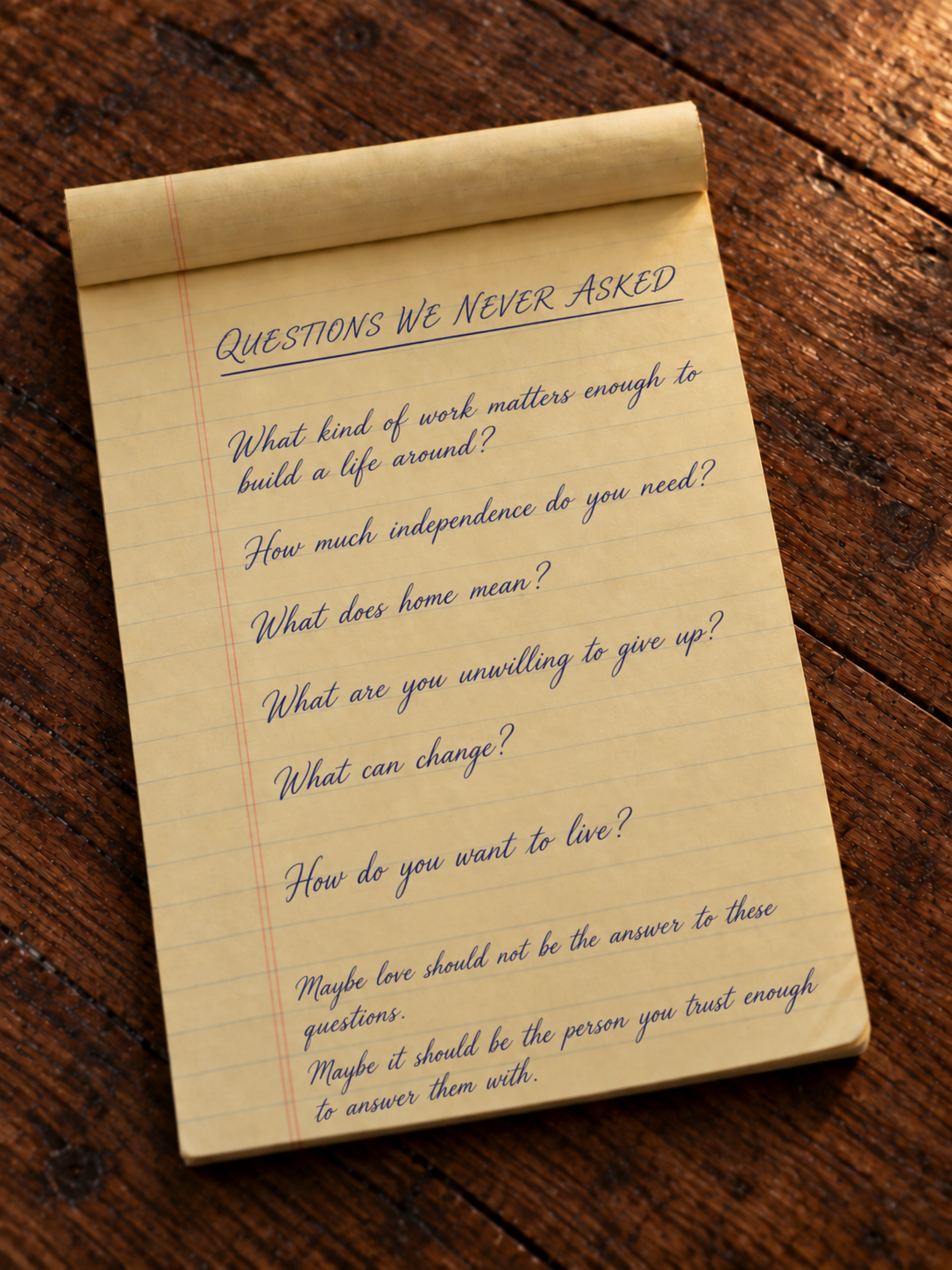
QUESTIONS WE NEVER ASKED
Then:
What kind of work matters enough to build a life around?
How much independence do you need?
What does home mean?
What are you unwilling to give up?
What can change?
And then:
How do you want to live?
She stopped.
That one stayed.
At the bottom she added:
Maybe love should not be the answer to these questions.
Maybe it should be the person you trust enough to answer them with.
Clara looked at the sentence.
Too sentimental?
Possibly.
She left it.
Her phone buzzed.
Jack.
Home?
She smiled.
Yes.
Good.
Then:
For the record, I was going to kiss you.
Clara stared.
Heat climbed into her face.
Ridiculous.
Forty-seven.
Still blushing at a text.
She typed:
I know.
A pause.
That’s rude.
Observation.
Did you want me to?
Clara's heart kicked.
There were moments when adult maturity was overrated.
She could evade.
Joke.
Redirect.
Instead:
Yes.
The three dots appeared.
Disappeared.
Returned.
Then:
Okay.
Clara laughed.
Okay?
I’m trying not to plan your answer for you.
She stared at the message.
Then smiled.
Damn him.
Goodnight, Jack.
Goodnight, Clara.
She put down the phone.
Did not sleep for hours.
Tomorrow:
IF YOU LOVED ME
For sixteen days, Clara and Jack have been circling the end.
Tomorrow, they finally stop.
No simplified version.
No blame.
No story polished by twenty-four years of distance.
They remember the argument that ended them.
And the sentence each of them wishes they had never said.