
Day 15 - His Offer
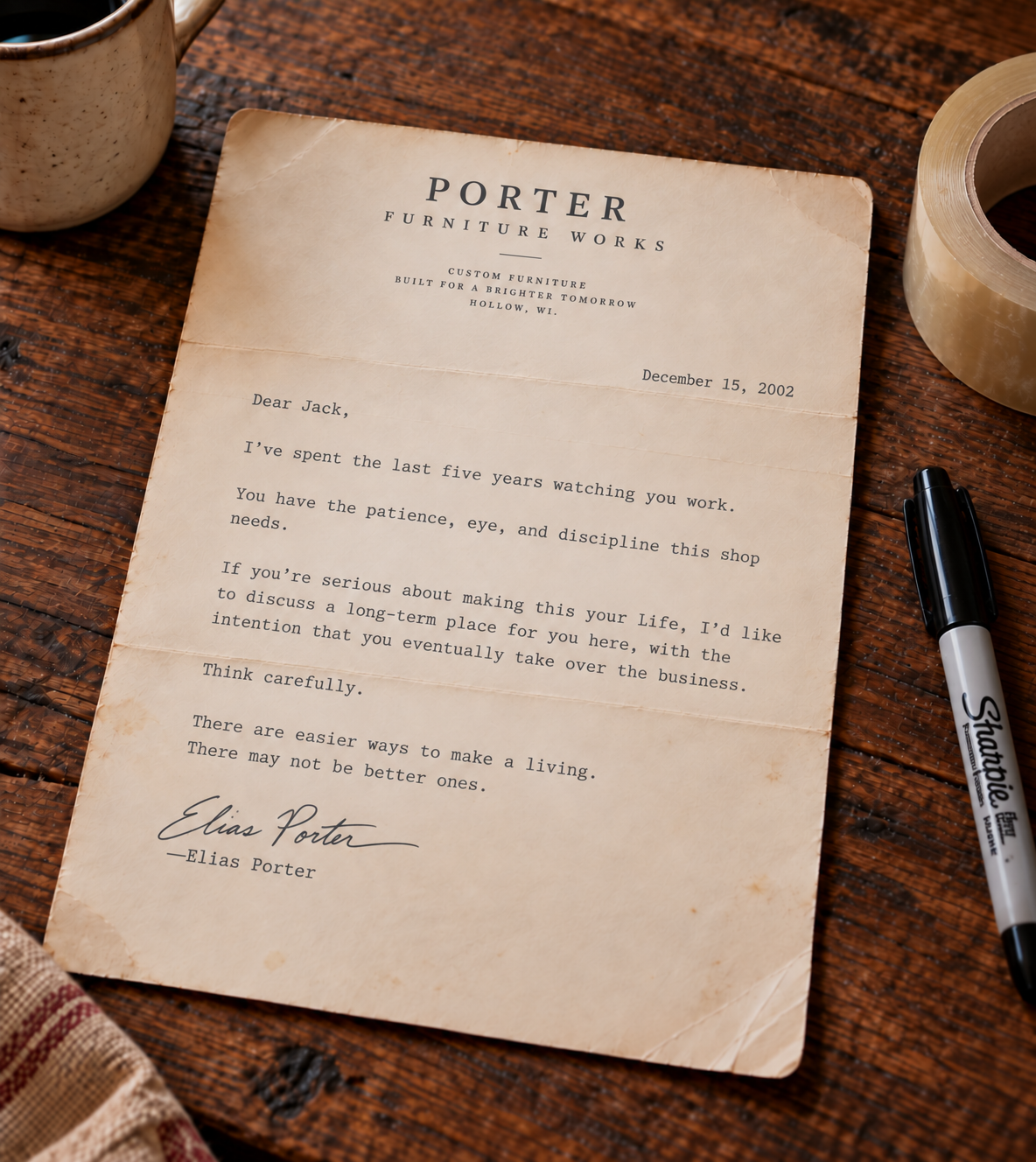
Clara read Elias Porter’s letter three times before calling Jack.
Not texting.
Calling.
He answered with background noise behind him.
Machines.
Voices.
The shop.
“Hey.”
“I found the letter.”
The noise seemed to recede.
Not because it actually did.
Because Jack stopped moving.
“Which one?”
“Porter Furniture Works.”
A pause.
“Right.”
“You knew Dad had this?”
“Not exactly.”
Clara looked at the cream paper.
“Why would he?”
“I don't know”
“Jack.”
“I genuinely don't know. I had shown it to Henry at some point. Maybe I left it there.”
She believed him.
That complicated things.
“Can you meet me later?”
Another pause.
“Yes.”
They met at Mercer Works after the shop closed.
By six, the building felt entirely different.
No machines.
No movement.
Just the old mill settling around them.
Jack had turned on lamps instead of overhead lights.
The workshop was warm.
Quiet.
Clara carried the letter in her bag.
She had expected to feel confrontational.
She didn’t.
Mostly, she felt embarrassed.
Not because she had done something unforgivable.
Because she had spent twenty-four years remembering the decision as if Jack had been choosing between:
Clara
and
not Clara.
The letter proved otherwise.
He had been choosing between futures too.
Jack handed her a mug.
Tea.
Not coffee.
Clara looked at it.
“Who are you?”
“It’s six o’clock.”
“I can drink coffee at six.”
“I know.”
“That sounded judgmental.”
“It was.”
She took the tea anyway.
They sat at a workbench near the back.
Clara pulled out the letter and placed it between them.
Jack looked at Elias’s signature.
Something in his face softened.
“You still talk to him?”
“No.”
Clara glanced up.
Jack looked at the letter again.
“He died five years ago.”
“Oh.”
“I’m sorry.”
“Thanks.”
A pause.
“He was good to me.”
Clara nodded.
The letter made more sense now.
Mentorship.
Inheritance of a craft.
Not literally, maybe.
But close.
“Tell me,” she said.
Jack looked at her.
“About Elias?”
“About this.”
She tapped the letter.
“What did it mean?”
Jack leaned back.
For a while, he didn’t answer.
Then:
“Everything.”
Clara swallowed.
Simple.
Clear.
Everything.
He looked toward the shop.
“As you know, I started with him when I was nineteen. Mostly cleanup. Sanding. Deliveries. I thought I knew things.”
“You didn't?”
“Almost nothing.”
“That seems consistent with nineteen.”
“Exactly.”
He smiled.
“Elias was hard on me.”
“Good hard?”
“Mostly.”
“He taught you?”
“Everything that mattered.”
Jack looked at his hands.
“Not just how to build. How to slow down. How to look at a piece long enough to understand where I was about to ruin it.”
Clara smiled faintly.
“That sounds like advice you could apply elsewhere.”
Jack looked at her.
“Apparently not at twenty-four.”
She laughed.
Fair.
He continued.
“The offer wasn’t really about taking over the shop right away. It was years down the road. But it meant he believed I could.”
Clara looked at the letter.
That feeling, she understood.
Someone established.
Someone respected.
Looking at you before you had fully become yourself and saying:
I see it.
Her first editor had done that for her.
So had Jack.
Maybe Henry too.
“I would’ve understood that,” she said quietly.
Jack’s expression changed.
“I know.”
Clara looked up.
“You didn't think I would.”
“I didn’t think you'd think it was enough.”
That hurt.
Not because he was trying to hurt her.
Because young Clara probably wouldn't have.
She looked around the workshop.
“Would I have?”
Jack did not rescue her.
“I don't know.”
Good.
She appreciated that.
Clara looked at the letter again.
“At the time, I thought you were choosing Holloway.”
“I was.”
“But not just Holloway.”
“No.”
“You were choosing this.”
Jack nodded.
“Before this existed.”
“Yes.”
There it was.
He had seen something invisible too.
Same as Clara and Chicago.
She had believed in a career before she had one.
Jack had believed in a shop before it existed.
They were more alike than either had understood.
That realization irritated her.
Mostly because it was late.
“Why didn’t you tell me about your offer?” Clara asked.
Jack rubbed his thumb against the edge of the mug.
“Because I was trying to decide.”
“What?”
“Whether I wanted it.”
“And?”
“I did.”
Clara went still.
He continued before she could respond.
“I also knew what saying yes probably meant.”
There it was.
The cost.
Not theoretical.
Her.
Clara looked away.
“So you decide not to tell me.”
“Yes.”
“That was cowardly.”
“Yes.”
No defense.
No excuse.
Clara almost smiled.
“At least you’ve evolved.”
“Therapy.”
She laughed.
Then went quiet again.
“Did you think I would ask you to turn it down?”
Jack took too long.
Clara’s stomach dropped.
“You did.”
“I thought you might.”
“Would I have?”
Jack looked at her.
“You kind of did.”
Clara opened her mouth.
Closed it.
He wasn’t wrong.
Not in those exact words.
But in implication.
If he loved her, he would come.
If he stayed, what did that mean?
She rubbed her forehead.
“I hate Past Clara.”
“I liked her.”
“She was impossible.”
“So was I.”
“Less visibly.”
“More passively.”
“That might be worse.”
“Probably.”
They smiled.
Then Clara said:
“I wish you'd told me.”
Jack nodded.
“I wish I had.”
“I wish I had asked better questions.”
He nodded again.
“I wish I answered the ones you did ask.”
There was no fixing it.
That was strangely peaceful.
No one had to win the historical argument.
Jack stood and walked toward a cabinet.
He opened a drawer.
Pulled out a notebook.
Old.
Black cover.
Corners softened.
Clara recognized it.
The one from Christmas 2002.
Her gift.
For the things you're going to make.
He placed it in front of her.
Clara stared.
“You still have this.”
“Yes.”
“Of course you do.”
Jack smiled.
“Apparently I’m predictable.”
She opened it.
Pages of furniture.
Tables.
Chairs.
Cabinetry.
Measurements.
Ideas.
Some crossed out.
Some abandoned.
Some eventually recognizable as pieces in the shop.
Then a page near the middle.
A house.
Small.
Not detailed.
More idea than plan.
A workshop beside it.
Kitchen.
Living room.
Upstairs room.
And there:
C’s desk
Clara touched the letters.
“You sent me a picture of this.”
“I did.”
“Why did you draw it?”
Jack looked embarrassed.
Which made her instantly more interested.
“I don’t know.”
“Jack.”
“I was twenty-four.”
“That’s not an answer.”
He sighed.
“I was trying to imagine what it would look like if you stayed.”
The words hung there.
Not manipulative.
Not romanticized.
Just honest.
Clara looked at the page again.
“What did you think I would do here?”
“Work.”
“From that desk?”
“I guess.”
“At what?”
Jack laughed softly.
“I didn’t get that far.”
She looked at him.
“So I was just supposed to materialize a career in Holloway?”
“Apparently.”
Clara laughed.
“Your plan was terrible.”
“Yes.”
She pointed at the page.
“You gave me a desk and no job.”
“You gave me three job leads and no vote.”
Clara froze.
Then laughed.
“There it is.”
“Symmetry.”
“Awful symmetry.”
“Very.”
She pulled her own yellow legal pad from her bag.
The Chicago plan.
She had brought it without really knowing why.
She placed it beside his notebook.
They looked at both.
Her bullets.
His sketch.
Her city.
His house.
Each one lovingly constructed around the other.
Each one missing the same thing.
Consent.
Not in some dramatic sense.
Just actual participation.
Clara shook her head.
“We were both planning someone else’s life.”
Jack nodded.
“Yeah.”
“Why didn't anyone stop us?”
“We were young.”
“That excuse again.”
“Still useful.”
Clara traced the edge of his sketch.
“Did you think this was enough?”
Jack knew what she meant.
The room.
The house.
The workshop.
A desk.
He took time.
“Yes.”
At twenty-three, that answer would have infuriated her.
At forty-seven, it didn't.
Because he wasn't saying:
It should have been enough for you.
Only:
It was enough for me.
Different thing.
Clara nodded.
“I get that now.”
Jack looked at her.
“I didn't get you then either.”
She smiled faintly.
“What didn’t you get?”
“How much the work mattered.”
“My work barely existed.”
“Exactly.”
Jack leaned forward.
“I thought you loved the idea of Chicago.”
“I did.”
“I didn't understand that you also loved the work itself.”
Clara sat back.
That was important.
She had always thought he resisted the city.
Maybe he had failed to see the calling inside it.
Just as she had failed to see his.
“We were both looking at the packaging,” she said.
Jack smiled.
“That sounds like editor language.”
“Occupational hazard.”
They walked through the shop before she left.
Jack showed her an old workbench Elias had built.
Worn surface.
Cuts.
Burn marks.
Ink.
Thousands of marks.
“You kept it.”
“Yeah.”
“Why?”
“Because I didn’t need a new one.”
Clara gave him a look.
“That is not the full answer.”
Jack smiled.
“No.”
He touched the bench.
“Because it reminds me I didn’t start here.”
Clara looked around.
Mercer Works.
Seven employees.
National work.
His name on the wall.
A business built across decades.
She suddenly understood the scale of his choice.
Not better than hers.
Equal to it.
“I owe you something,” she said.
Jack frowned.
“What?”
“An apology.”
He looked immediately uncomfortable.
Good.
Let him.
Clara continued.
“I thought you were choosing the easier life.”
Jack didn't say anything.
“I thought staying meant you were afraid.”
He looked down.
“I know.”
“I was wrong.”
Jack nodded once.
“Thank you.”
Not it’s okay.
Not you don’t have to apologize.
Thank you.
That mattered.
Then he said:
“And I thought you believed a life only counted if other people could see it.”
Clara blinked.
“Ouch.”
“I know.”
“Were you wrong?”
Jack smiled faintly.
“Eventually.”
She laughed.
“Fair.”
Then he added:
“I’m sorry.”
Clara nodded.
“Thank you.”
Equal.
Again.
At the front door, Clara put on her coat.
Jack leaned against the frame.
“You taking the table?”
She looked at him.
“How do you know?”
“Henry's house has a realtor sign coming.”
“News travels fast.”
“Holloway.”
“Right.”
“Yes. I’m taking it.”
“Good.”
“It barely fits.”
“It'll fit.”
“How do you know?”
“I made it.”
“That is not how apartments work.”
Jack laughed.
“I can modify the base if needed.”
She stared.
“What?”
“Nothing destructive. Make it easier to move.”
“You'd do that?”
“Of course.”
The answer came too easily.
Clara felt it.
She looked away.
“Thanks.”
Then Jack said:
“You know you don't have to decide everything before you leave.”
Clara looked back.
“What do you mean?”
“The house. The furniture. All of it.”
“I have a flight.”
“I know.”
“A job.”
“I know.”
“A life.”
“I know.”
There was no challenge in his voice.
That stopped her.
Jack continued.
“I’m not asking you to change anything.”
The words landed somewhere deeper than they should have.
Because young Jack had asked.
Young Clara had asked too.
Maybe this was what growth looked like.
Not wanting less.
Asking differently.
Clara nodded.
“I know.”
And she did.
Back at her Dad’s house, Clara placed the two artifacts side by side on the dining table.
Her job offer.
Jack's Porter letter.
Both dated December 2002.
Both life-changing.
Both real.
For years, she had remembered only hers.
Now she understood why the ending had been impossible to simplify.
It had never been:
love or ambition.
It had been:
whose ambition?
And they had not known how to build a third answer.
Not yet.
Tomorrow:
YOUR PLAN FOR ME
The question is no longer whether Clara and Jack loved each other.
They did.
Tomorrow, they finally confront the harder truth:
Sometimes love can become controlling without meaning to.
And both of them were guilty of it.