
Day 13 - The Other Half
Jack texted at 10:06 AM.
Are you home?
Clara looked at the time.
Then at the boxes in the hallway.
Then at the realtor's staging checklist lying face-down on the table because she had grown tired of being judged by a piece of paper.
Yes. Why?
I found something.
Clara smiled.
Apparently this was how December worked now.
People found things.
Mostly Jack.
Mostly things Clara wasn't emotionally prepared for.
Should I be worried?
Probably.
Helpful.
I’m coming by.
She stared at the message.
No question.
No “if that’s okay.”
Just a fact.
A week ago, that would have irritated her.
Today, she put the kettle on.
Progress was humiliating.
Jack arrived fifteen minutes later carrying a shoebox.
Not metaphorically.
An actual old shoebox.
Clara opened the door and immediately looked at it.
“No.”
Jack smiled.
“Good morning.”
“What is that?”
“Evidence.”
“I've had enough evidence.”
“That’s objectively false.”
He stepped inside.
Removed his boots.
Carried the box to the dining room.
Clara followed.
“What did you find?”
Jack placed it on the table.
The box was old.
Brown cardboard.
Soft at the corners.
Someone had written CHRISTMAS on one side in black marker.
Not Jack.
Different handwriting.
“Where was it?”
“My house.”
“That narrows things down.”
“Closet upstairs.”
“You keep a Christmas shoebox in an upstairs closet?”
“Apparently.”
Clara folded her arms.
“Open it.”
Jack looked at her.
“You’re bossy.”
“You brought it here.”
“Fair.”
He lifted the lid.
Postcards.
Clara stopped breathing for half a second.
Not because she didn't understand what they were.
Because she did.
Immediately.
Her handwriting.
Her stamps.
Her terrible habit of writing all the way into the margins.
Five postcards.
One for each Christmas.
Jack had kept them.
Of course he had.
And somehow Clara had never considered that possibility.
“You have mine.”
Jack nodded.
“Yes.”
“All of them?”
“I think so.”
She reached toward the stack, then stopped.
“Can I?”
Jack looked at her strangely.
“They’re yours.”
“No. They’re yours.”
A small pause.
“Right.”
That mattered.
He pushed the box toward her.
“Go ahead.”
Clara picked up the first one.
Main Street in summer.
The one she sent after the Ashby.
She knew the words before reading them.
The furniture argument.
The booth.
Her insistence that she had won.
Then the second.
A lake.
The twelve-dollar tree.
Then a postcard she had forgotten entirely.
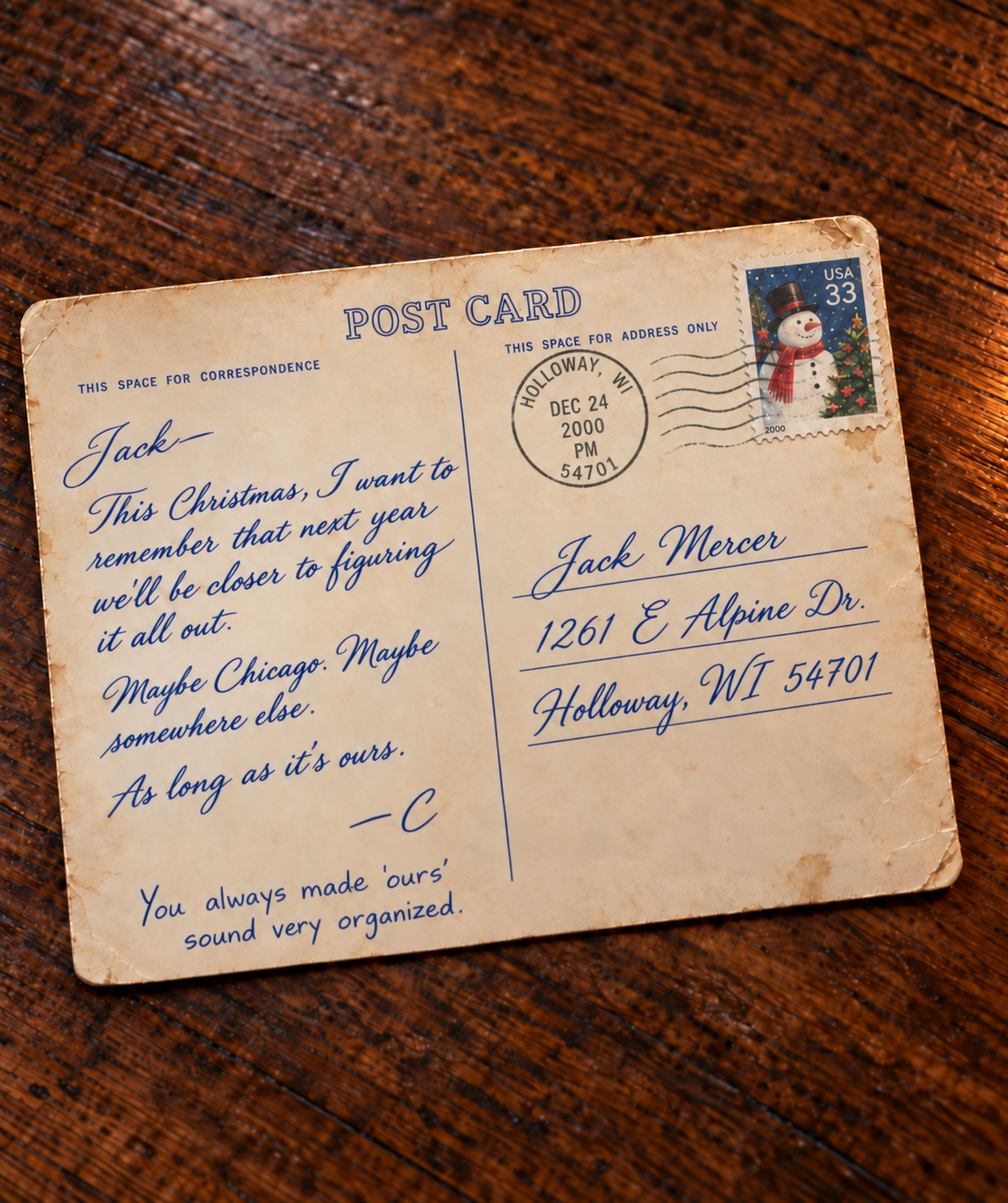
Christmas 2000.
She turned it over.
Read.
This Christmas, I want to remember that next year we’ll be closer to figuring it all out.
Maybe Chicago. Maybe somewhere else.
As long as it’s ours.
Clara stared.
Jack was watching her.
She hated that.
“What?”
He shook his head.
“Nothing.”
“No. What?”
“You’re making the face.”
“What face?”
“The one where you realize Past Clara has become professionally inconvenient.”
Clara laughed despite herself.
“She sounds exhausting.”
“I liked her.”
“That reflects poorly on you.”
“Probably.”
Clara read the card again.
As long as it’s ours.
At first glance, romantic.
Simple.
Then she noticed it.
Not what she had written.
What she had assumed.
There was no question.
No uncertainty.
No room.
The future would be theirs, yes.
But she had already begun defining the terms.
City.
Career.
Movement.
Forward.
She looked at Jack.
“Did this bother you?”
He leaned back in the chair.
“Then?”
“Yes.”
“Not exactly.”
“That is not an answer.”
“It scared me a little.”
Clara's expression changed.
“Why?”
Jack nodded toward the card.
“You sounded so sure.”
“I wasn’t.”
“I know that now.”
“And then?”
“Then I thought if you sounded sure, I was supposed to be sure too.”
Clara looked back at her own handwriting.
That was painfully familiar.
“Why didn’t you say that?”
Jack gave her a look.
“Because apparently twenty-something men are famously gifted at articulating nuanced emotional uncertainty.”
Clara laughed.
“Fair.”
Then quieter:
“I thought certainty was attractive.”
“It was.”
She looked up.
Jack smiled.
“It was also terrifying.”
They went through the postcards slowly.
No rush.
No chronology for the sake of chronology.
Just two people reading the paper versions of themselves.
One card made them laugh.
Another made Clara cringe.
On one, she had written:
We are absolutely never becoming boring adults who talk about mortgage rates.
Jack tapped the line.
“That aged beautifully.”
Clara groaned.
“I refinanced twice.”
“I have opinions about commercial lease structures.”
“Delete it.”
“No.”
Another read:
I hope we always know how to leave when something gets too small.
Clara stared at that one longer.
Jack noticed.
“You okay?”
“Yes.”
She wasn't sure.
At twenty-one, she had meant jobs.
Apartments.
Cities.
Maybe relationships.
At forty-seven, the sentence felt less courageous.
More like an instruction she had been giving herself for years.
Leave before something contains you.
Leave before you become stuck.
Leave before staying becomes failure.
She looked at Jack.
“Did I always talk like this?”
“Pretty much.”
“Gross.”
“You were passionate.”
“That is the diplomatic word.”
“You were alive.”
Clara went quiet.
That landed differently.
Because he was right.
She had been.
Very.
Sometimes too much.
But alive.
She picked up the next postcard.
Christmas 2001.
The good Christmas.
Her handwriting curved around the back.
This Christmas, I want to remember your terrible dancing, my father pretending not to watch, and the fact that you gave me a portfolio like you somehow already knew I’d need somewhere to put the life I wanted.
Clara swallowed.
Then:
Thank you for never making me feel ridiculous for wanting more.
She stopped.
Jack looked down.
That one hurt.
Not because it was false.
Because it was true.
Before the fracture, he had supported her.
Encouraged her.
Helped her leave.
That complicated the story she had carried for years.
Clara had often remembered Jack as the person who asked her to stay.
She had forgotten how long he had helped her go.
She placed the card down.
“I did this.”
Jack frowned.
“What?”
“I reduced you.”
His expression shifted.
“To what?”
“The person who wanted me to stay.”
Jack didn’t answer.
Clara looked at him.
“That’s who you became in the story I told myself.”
He was quiet a long time.
Then:
“Probably easier that way.”
She nodded.
“Yes.”
“Same for me.”
Clara blinked.
“How?”
“I turned you into the person who needed to leave.”
“But I did.”
“Yes.”
“That’s accurate.”
“Partly.”
He leaned forward.
“You were also the person who showed up when Elias’s mother died.”
Clara went still.
“You remember that?”
“Of course.”
She smiled.
Jack continued.
“You were the person who sat in a hospital waiting room with my sister when she broke her wrist.”
“I forgot that.”
“I didn’t.”
Clara looked down.
“You stayed plenty.”
That sentence found its mark.
Because Clara had made leaving such an essential part of her identity that she had forgotten she had also known how to stay.
For people.
For love.
For moments.
Maybe she had always contained both.
That felt like a relief.
Jack picked up one of the postcards.
Christmas 2002.
Clara's last one.
He did not turn it over.
Not yet.
Clara noticed.
“That’s the one.”
“Yes.”
“The last Christmas.”
“Yes.”
The room changed.
Subtle.
Immediate.
Clara looked at the front.
A photograph of Chicago at night.
She remembered buying it.
Remembered standing at a drugstore rack again, years after the first diner postcard.
Remembered believing the future was close enough to touch.
“Read it,” she said.
Jack looked at her.
“You sure?”
“No.”
He smiled faintly.
“Honest.”
“Read it anyway.”
Jack turned the card over.
Clara's handwriting was smaller.
Less playful.
Jack—
This Christmas, I want to remember that whatever happens next, we were here first. I know everything feels complicated right now.
I still believe we can figure it out.
I love you.
—C
Clara closed her eyes.
There it was.
No city.
No plan.
No bravado.
Just fear.
And hope.
She had forgotten that too.
Jack placed the card down carefully.
“You meant it.”
Clara opened her eyes.
“Yes.”
“I know.”
“Did you?”
“Then?”
“Yes.”
Jack looked at the card.
“Mostly.”
Mostly.
There was that word again.
The space between what people say and what other people can hear.
Clara breathed out.
“I thought I was being clear.”
“You were.”
“Then why mostly?”
“Because by then I was scared too.”
He looked at her.
“I kept hearing everything through the question underneath it.”
“What question?”
“Are you coming with me?”
Clara's throat tightened.
That was fair.
She had not written it.
But it was there.
Between every line.
Maybe not as a threat.
Still there.
“And what were you trying to say?” she asked.
Jack took his time.
“I love you.”
He paused.
“And I don't know if I can.”
Clara looked at him.
“That would've been useful.”
“I know.”
They both laughed.
Not because it was funny.
Because sometimes twenty-four years was enough distance to see how preventable pain could still be unavoidable when people did not yet have the language they needed.
Clara picked up one of the earlier cards again.
The one with:
As long as it’s ours.
She turned it over.
At the bottom was the penciled note she had not noticed at first.
Jack's handwriting.
Added later.
You always made “ours” sound very organized.
Clara stared.
“When did you write that?”
Jack looked over.
“I have no idea.”
“After?”
“Probably.”
“After we broke up?”
“I think so.”
Clara smiled sadly.
“Accurate.”
“You did love a folder.”
“I still love a folder.”
“I believe it.”
She looked at the shoebox.
“How long have you kept these?”
Jack shrugged.
“Since you sent them.”
“That is technically not an answer.”
“It’s literally the answer.”
“You moved houses.”
“Yes.”
“You got married.”
“Yes.”
“You had a child.”
“Yes.”
“You got divorced.”
“Yes.”
“You moved again.”
“Yes.”
“And these just came with you?”
Jack nodded.
Clara studied him.
“Why?”
His answer was simple.
“Because they were mine.”
There it was.
No grand declaration.
No “because I never stopped loving you.”
Thank goodness.
Because that would have ruined it.
He had kept them because they belonged to his life.
Because history did not become disposable simply because a chapter ended.
Clara understood that now.
Maybe better than she once could have.
She looked at the postcard stack.
“You didn’t hide them from Rachel?”
“No.”
“Did she ever read them?”
“A few.”
Clara blinked.
“Really?”
“Yes.”
“And?”
Jack smiled.
“She said you used too many exclamation points.”
Clara gasped.
“I did not.”
“You absolutely did.”
“Show me.”
Jack handed her the first card.
Three exclamation points in five lines.
Clara covered her face.
“Fine.”
He laughed.
“She liked you.”
“What?”
“She never met me.”
“No. The version of you in the cards.”
Clara didn’t know what to do with that.
So she said, “That is a very emotionally evolved thing to tell your ex-girlfriend.”
“I've been in therapy.”
Clara stared.
Then burst out laughing.
Jack smiled.
“What?”
“Nothing. I just didn’t know.”
“Why would you?”
“No reason.”
A pause.
Then:
“Good.”
Jack nodded.
“Very.”
And somehow that one word carried years.
Work.
Marriage.
Divorce.
Fatherhood.
Growth.
A life.
Clara liked knowing he had done the work.
She liked that she had too.
Maybe that mattered more than chemistry.
Maybe it was why the chemistry felt different now.
Less dangerous.
More possible.
After Jack left, he took the shoebox with him.
Clara was glad.
Those postcards were his.
She had her half.
He had his.
Separate archives of the same relationship.
It felt right.
Before leaving, though, he handed her one postcard.
The 2000 card.
As long as it’s ours.
“Why?”
Jack shrugged.
“You were looking at it like you wanted to interrogate it.”
Clara smiled.
“I might.”
“Bring it back.”
“I will.”
Not keep it.
Borrow it.
That distinction mattered too.
That evening, Clara sat at the table with the postcard and opened her laptop.
Not work.
A blank document.
She typed:
THINGS I THOUGHT I KNEW ABOUT JACK
Then stared.
Deleted it.
Too clinical.
She tried again.
THINGS I THOUGHT I KNEW ABOUT US
Deleted that too.
Finally:
WHAT I REMEMBERED WRONG
She stopped.
That one stayed.
Underneath:
1. Jack wanted a smaller life.
She looked at the words.
Then crossed them out.
2. I was the only one with ambition.
Crossed out.
3. He wanted me to stay because he didn't understand why I needed to leave.
She hesitated.
Crossed out.
Then:
4. I was clear about what I wanted.
Clara laughed.
“That one can go.”
Crossed out.
She sat back.
The page looked like a document someone had violently edited.
Appropriate.
At the bottom she wrote:
Maybe memory isn't dishonest. Maybe it's just incomplete.
She looked at that.
Then closed the laptop.
Her phone buzzed.
Jack.
Theo says you can keep the postcard if you promise to correct the caption.
Clara smiled.
Theo is becoming too involved in this relationship.
The response came immediately.
What relationship?
Clara froze.
There it was again.
Same question.
Different day.
Different weight.
She stared at the screen.
Then typed:
The one between your Ash table and my editorial integrity.
A pause.
Coward.
Clara laughed.
Goodnight, Jack.
Goodnight, Clara.
She put the phone down.
Then looked at it again.
What relationship?
Not past.
Not exactly present.
Something.
She wasn't ready to name it.
That didn't mean it wasn't there.
Tomorrow:
THE OFFER
Clara finally opens the envelope she has been avoiding since the first day.
Inside is the Chicago job offer that changed her life.
And for the first time in twenty-four years, she is going to let herself remember how badly she wanted it.