
Day 10 - The Feature
Clara read the sentence at 7:42 in the morning.
Then again at 7:43.
Then she closed the document.
Opened it again.
Same sentence.
Still there.
The transcript had arrived in her inbox from Dana Whitaker, now freelance and living somewhere in Vermont.
Clara had sent a casual message the night before.
Do you happen to still have your raw notes from the Mercer Works feature?
She had expected:
No.
Or:
Maybe on an old hard drive.
Instead, at six thirty the next morning:
Of course. I keep everything. Attached. Also, Jack Mercer was one of my favorite interviews that year. Dry as hell.
Clara had downloaded the file before getting out of bed.
This had been a mistake.
Now she sat against the headboard with reading glasses she resented needing and the laptop balanced across her knees.
The interview was thirty-eight pages long.
Dana had transcribed nearly everything.
Furniture.
Materials.
Training.
Business.
The decline of traditional craft apprenticeships.
Regional manufacturing.
Sustainability.
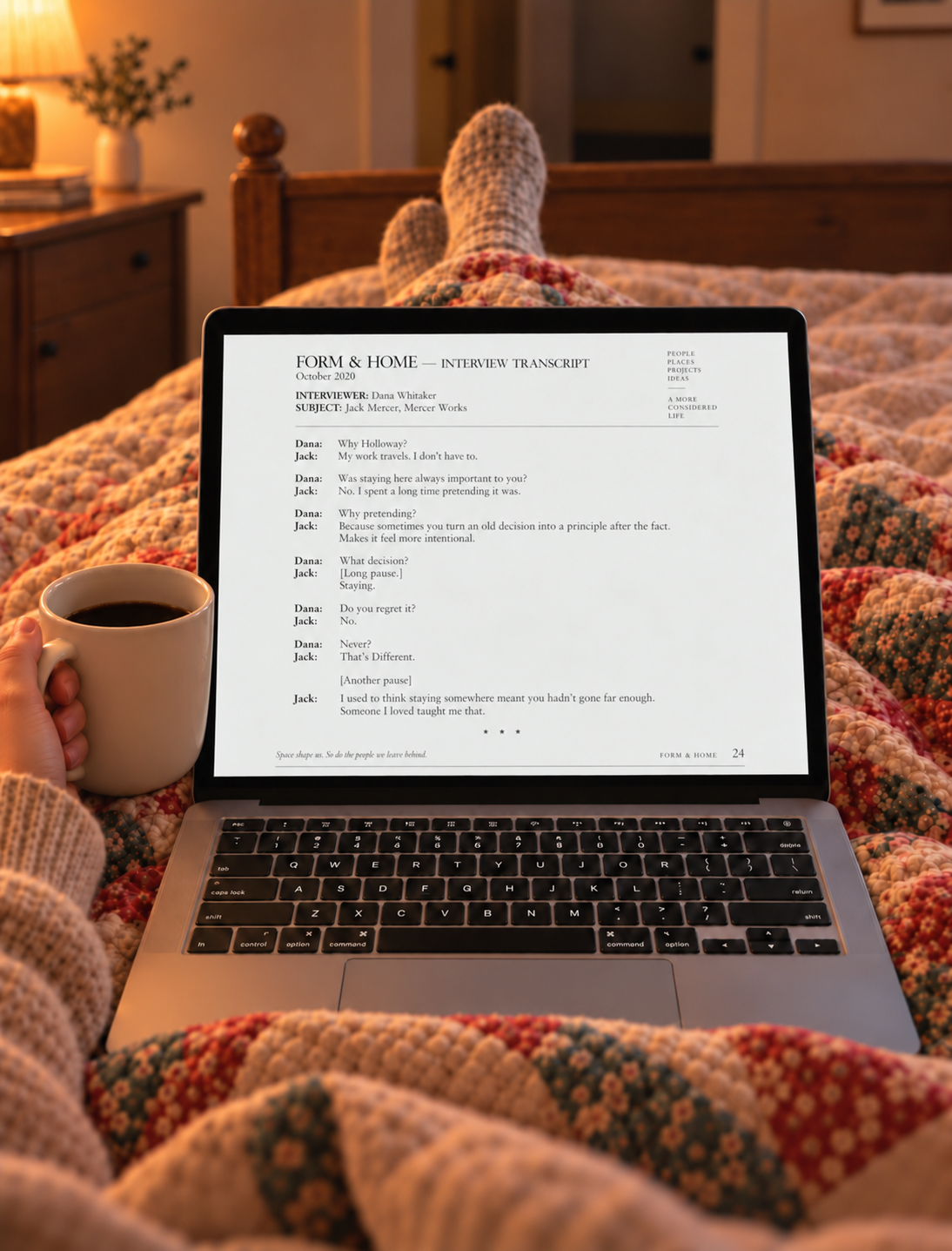
At page twenty-four came the question.
Why Holloway?
Jack's published answer appeared first.
My work travels. I don't have to.
Clara knew that one.
Then Dana had asked:
Was staying here always important to you?
And Jack had answered:
No.
Clara stopped.
Continued.
I spent a long time pretending it was.
Dana:
Why pretending?
Jack:
Because sometimes you turn an old decision into a principle after the fact. Makes it feel more intentional.
Clara's chest tightened.
Dana:
What decision?
There was a notation.
[Long pause.]
Then Jack:
Staying.
Dana:
Do you regret it?
No.
Never?
That's different.
Another pause.
Then:
I used to think staying somewhere meant you hadn't gone far enough. Someone I loved taught me that.
Clara held completely still.
Dana:
And now?
Jack:
Took me a long time to figure out she was right about leaving—and wrong about staying.
That was where the published article moved on.
Not because Dana had cut something scandalous.
Because editors cut.
Context disappeared.
Word counts existed.
A sentence that might have meant everything to two people was simply one sentence too many for the spread.
Clara read it again.
Someone I loved.
Not loved once.
Not an old girlfriend.
Someone I loved.
Past tense grammatically.
Past tense emotionally?
She immediately became annoyed with herself.
This was why unpublished transcripts should remain unpublished.
Too much oxygen.
Too much room to assign meaning.
Clara closed the laptop.
Opened it again.
Read the sentence one more time.
“Enough.”
She got out of bed.
At nine, she called Naomi.
No greeting.
“I found something.”
Naomi groaned.
“It is nine in the morning.”
“You're awake.”
“I can be awake and resentful.”
“The magazine interview.”
“What magazine interview?”
“The Jack feature.”
Silence.
Then Naomi became awake.
“Oh.”
“I got the original transcript.”
“Why?”
Clara walked downstairs.
“To read it.”
“Excellent. Good. Very normal.”
“Do you want to hear this or not?”
“I desperately do.”
Clara reached the kitchen and opened the refrigerator without purpose.
She read the excerpt aloud.
Naomi did not interrupt.
This was how Clara knew it mattered.
When she finished, there was a long pause.
Then Naomi said:
“Well.”
“That's not helpful.”
“I am trying not to make the sound I actually want to make.”
“What sound?”
“The one that will cause you to hang up.”
Clara took out milk.
Put it back.
“Do you think he meant me?”
Naomi laughed.
Clara closed her eyes.
“Forget I asked.”
“No, no. I'm sorry. It's just—Clara.”
“What?”
“You were the woman he loved who left Holloway because she thought staying meant not going far enough.”
“There could have been several.”
“In Holloway?”
“Naomi.”
“Fine. Maybe Jack had an entire secret society of ambitious women fleeing Wisconsin.”
Clara leaned against the counter.
“It's been twenty-four years.”
“Yes.”
“He married someone else.”
“Yes.”
“So did I.”
“Yes.”
“He loved Rachel.”
“Of course he did.”
“I loved Michael.”
“I know.”
“So this doesn't mean—”
“Clara.”
“What?”
“Stop trying to figure out what it means.”
Clara went quiet.
Naomi softened.
“It means you mattered to him.”
Clara looked toward the dining room.
The box.
The postcards.
The tape.
The table.
“That shouldn't be surprising.”
“No.”
“But it is.”
“Why?”
Clara knew.
She just didn't like the answer.
“Because I think I told myself he got over it faster.”
Naomi was quiet.
“Did that make leaving easier?”
“Yes.”
There it was.
Simple.
Ugly.
Human.
Clara sat down.
“I think I needed to believe he was fine.”
“You were twenty-three.”
“I keep using that excuse.”
“It isn't an excuse. It's context.”
Clara rubbed her forehead.
“He was fine eventually.”
“Probably.”
“He had a whole life.”
“Yes.”
“So did I.”
“Yes.”
Naomi paused.
“And neither of those things means you didn't hurt each other.”
Clara looked down.
“No.”
“It also doesn't mean you made the wrong choice.”
That one landed.
Because some part of Clara had begun trying to rewrite history in exactly that direction.
If Jack still mattered—
If the postcards mattered—
If he had remembered—
Maybe leaving had been the mistake.
But no.
She had needed Chicago.
She knew that.
Even now.
Especially now.
“Thank you,” Clara said.
“For what?”
“Not turning this into fate.”
Naomi snorted.
“I know you too well.”
At ten thirty, Clara downloaded the transcript and moved it into a folder labeled:
JACK / DO NOT OVERINTERPRET
Then she went back to work.
She lasted thirty-eight minutes.
At 11:08, she texted him.
Dana Whitaker sends her regards.
No answer.
At 11:14:
That sounds ominous.
I read your original interview transcript.
A longer pause.
Then:
Oh no.
Clara smiled.
Why oh no?
Because interviews should expire after publication.
They don't.
I’d like to formally request they do.
She stared at the screen.
This was the moment.
She could let it go.
She did not.
Who taught you that staying somewhere meant you hadn’t gone far enough?
Nothing.
Three dots.
Gone.
Nothing.
Clara immediately regretted asking.
Then her phone rang.
Of course.
She answered.
“Hi.”
Jack's voice was dry.
“You're very subtle.”
“I learned from journalism.”
“You're in magazines.”
“Still journalism.”
“Debatable.”
Clara smiled despite herself.
“Jack.”
He exhaled.
“Yes.”
One word.
No dodge.
No confusion.
Clara went still.
“You meant me.”
“Yes.”
She sat down.
The answer had been obvious.
Hearing it was different.
“Okay.”
“That’s all?”
“I don't know what I'm supposed to say.”
“You asked.”
“I know.”
Another pause.
Then Jack said, “It wasn't an accusation.”
“I didn't think it was.”
“Good.”
Clara touched the edge of the table.
“Was I really that awful about Holloway?”
Jack laughed softly.
“No.”
“That's not what the transcript suggests.”
“You were young.”
“So were you.”
“Yes.”
“And I thought staying meant failing.”
“You thought staying meant being afraid.”
Clara closed her eyes.
There it was.
More precise.
“Yes.”
Jack continued.
“You didn't understand why I wanted this place.”
“No.”
“And I didn't understand why you couldn't breathe here.”
Clara swallowed.
“Couldn't breathe is dramatic.”
“You were dramatic.”
“So were you.”
“Absolutely.”
She smiled.
Then asked the question that had been bothering her.
“Did you ever think I was right?”
Jack took time.
“About leaving?”
“Yes.”
“For you? Always.”
Clara looked up.
“Always?”
“Pretty much.”
“Even when we broke up?”
“That wasn't the part I thought you were wrong about.”
She knew better than to ask.
Asked anyway.
“What part?”
Jack was quiet.
“The part where you thought I had to want the same thing for us to work.”
Clara said nothing.
There.
Not the whole breakup.
Not yet.
But the outline of it.
She picked at a tiny scratch on the tabletop.
“You wanted me to stay.”
“Yes.”
“That sounds contradictory.”
“It was.”
Jack's voice softened.
“I was twenty-four, Clara. I could understand why you needed to go and still hate that you were going.”
Her throat tightened.
“That seems fair.”
“It didn't feel fair then.”
“No.”
“You wanted clean answers.”
“I still like clean answers.”
“I've noticed.”
She smiled.
“And you?”
“What about me?”
“You wanted me to just understand you without explaining anything.”
Jack laughed.
“That also tracks.”
“Infuriatingly.”
“Probably.”
They were quiet again.
Then Clara asked:
“Did Rachel know about me?”
Jack took a breath.
“Yes. I told you that.”
“Not just that I existed?”
“No.”
Clara waited.
He continued.
“When we got serious, we talked about past relationships. You were part of mine.”
“How much?”
“Enough.”
“That's vague.”
“Intentionally.”
She smiled.
“Did it bother her?”
“No.”
“Never?”
“Clara.”
“What?”
“She knew I loved her.”
That shut down the question beautifully.
Not defensive.
Not sentimental.
True.
Clara nodded even though he couldn't see her.
“Right.”
Jack added, “Your husband knew about me?”
“Michael? Yes.”
“How much?”
Clara smiled.
“Enough.”
“That's vague.”
“Intentionally.”
Jack laughed.
“Fair.”
They had both done it.
Turned one another into a story told to someone else.
Reduced years to enough.
Strange.
Necessary.
After the call, Clara returned to the transcript.
Not the quote about leaving.
A different section.
Dana had asked:
What do you want people to feel when they live with something you've made?
Jack's answer:
Nothing specific. I don't think objects should tell people how to feel.
I just want the piece to have enough integrity that it can be there for whatever happens around it.
Clara smiled.
That was better than the published quote.
Then another question:
What makes a house feel like home?
Jack:
Repetition, probably.
Same coffee cup. Same chair. Same person dropping their keys in the wrong place for fifteen years.
Eventually ordinary things become evidence.
Clara stopped.
Ordinary things become evidence.
She looked around the house.
The brass hooks.
The table.
The handwriting.
The broken felt Santa.
The recipe card.
Yes.
Exactly.
She copied the quote into her notes.
Then stopped.
That was something Clara did professionally.
Pulled language.
Identified what carried the piece.
For the first time, she wondered what an article about Jack would look like if she were editing it now.
Not because he had once loved her.
Because his work was good.
Because his ideas were interesting.
Because she understood what he was doing.
That distinction mattered.
She opened a blank document.
Typed:
THE THINGS WE LIVE WITH
Then immediately closed it.
“No.”
Too much.
Definitely too much.
In the afternoon, Clara drove to the post office to forward some of her Dad’s mail.
On the way back she passed the Ashby.
This time she stopped.
The diner still existed.
Smaller than she remembered.
Of course.
Places from adolescence always were.
The postcard rack was gone.
The chrome was duller.
Someone had painted the trim dark blue.
Clara went inside.
Same long counter.
Different stools.
A waitress she didn't know.
She chose a booth by the window.
Not the booth.
She didn't know which one had been theirs.
That surprised her.
Memory had preserved the conversation but not the furniture.
“Coffee?” the waitress asked.
Clara smiled.
“Yes.”
“One?”
Clara nearly laughed.
“One.”
She ordered apple pie.
Because apparently subtlety was over.
The pie arrived warm.
Better than she remembered.
Or maybe worse.
Impossible to know.
Clara ate half.
Then took a picture.
She stared at Jack's name in her messages.
Typed:
Guess where I am.
Deleted it.
Too cute.
Typed:
The Ashby still has terrible coffee.
Sent.
A minute later:
Blasphemy.
Then:
Pie?
Obviously.
Parking lot?
Clara laughed.
I’m eating indoors like an adult.
Coward.
She smiled.
The waitress passed and looked at her smiling at the phone.
Clara immediately put it facedown.
Ridiculous.
At forty-seven, apparently she could still be embarrassed by being seen happy.
That felt worth examining later.
Not today.
When Clara finished, she went to the register.
Beside it was not a postcard rack.
But there was a little display of local prints.
One showed the Ashby in winter.
Not glossy.
Not idealized.
A pen-and-ink drawing.
She bought it.
Five dollars.
The cashier handed it to her.
“Gift?”
Clara looked at the print.
“No.”
Then changed her mind.
“Maybe.”
Back at the house, she placed the print beside the first postcard.
Same diner.
Different picture.
She liked that.
Her phone buzzed.
Jack.
A photograph.
His workbench.
On it lay a small rectangular piece of pale wood.
Written in pencil:
ASH
Below it:
Just making sure the record is clear.
Clara laughed.
The record has been updated.
Jack responded:
Perfect.
Clara looked at the word.
Ordinary.
Harmless.
Still, she looked toward the box her father had labeled the same way.
KEEP
And for just a moment, the word seemed much bigger than it was.
Tomorrow:
THE TRAIN TICKET
December 2001.
One ticket from Holloway to Chicago.
One weekend Clara thought would prove Jack could fit inside the future she wanted.
Instead, it was the first time either of them understood that love and direction might not be the same thing.